Trump Crypto Ethics Deal Fails to End CLARITY Act Objections

Walmart CEO John Furner is turning the retailer’s 5,200 U.S. stores into an unstoppable AI engine
- Investment Opportunities Markets
 Peter Lynch
- 26 minutes read
As he belts the last note of his pop hit “Mystical Magical,” Benson Boone, in a white muscle tee and skintight jeans, backflips off his piano—and 10,000 people inside the Bud Walton Arena in Fayetteville, Arkansas, erupt into raucous applause. And he’s just the warm-up act. Boone is followed by Shaboozey, who sends the audience line dancing in the aisles, then Pink, who blasts through her hits.
But the morning’s biggest rock-star reception is reserved for a clean-cut guy in a gray suit jacket, his hair flecked with silver. He steps into the spotlight, an electric guitar slung across his chest, and rips into the intro of Journey’s “Don’t Stop Believin’.” The crowd lets loose its largest cheers yet.
John Furner, 51 and just four months into his role as CEO of Walmart, has been preparing for the spotlight for more than three decades. This Friday morning concert in early June is the culmination of Walmart’s Associates Week, the company’s annual celebration of the people who stock its shelves and ring up its customers. Some 6,500 Walmart workers have flown into Arkansas from 19 countries and across the United States to hear what Furner has planned for the 64-year-old company. After all, he used to be one of them.
Furner started working at Walmart when he was 18, as a part-time associate in the garden center of Walmart Store 100 in Bentonville, close to the company’s headquarters. He rose through the ranks, taking on roles that included assistant store manager, district manager, buyer, and head of marketing and merchandising for Walmart China, before being named CEO of Sam’s Club, the company’s warehouse chain, in 2017. Two years later, he took over Walmart U.S., the company’s largest division, and in February, he ascended to the top job.
Though Furner only plays the opening bars of “Don’t Stop Believin’” before launching into his keynote address, it’s a fitting anthem for his CEO debut. He must persuade Walmart’s 2.1 million workers to maintain their faith in the company—and in their place in its future—at a moment of massive upheaval. Technology is reshaping how associates spend their days: Walmart is urging them to take its new ChatGPT and Gemini certification courses, automate parts of their jobs with an internal vibe-coding tool, and carry an AI-enabled smartphone that coaches them through their daily tasks, like identifying produce freshness as they walk the store. Meanwhile, robots scrub floors and tape up cardboard boxes, while artificial intelligence routes trucks and identifies shelves that need restocking faster than any human could.
If Walmart’s AI bets pay off, they will remake the company. They could also have collateral damage, in a way that’s top of mind for many people in the arena. Furner tells his employees that AI is not a threat to their careers but the thing that will keep them relevant. “It’s our responsibility to help you build the skills that will lead the future of retail,” he says. “The future of Walmart.”
He’s picking up the reins from his predecessor, Doug McMillon, a retail legend who had spent the previous 12 years rebuilding Walmart into a digital powerhouse, second only to Amazon in U.S. online sales. By the time he handed the company to Furner, Walmart’s market value had quadrupled.
Furner has no intention of merely keeping the registers ringing: He wants to supercharge Walmart’s growth by adopting emerging technologies. Last year, when Furner was running Walmart U.S., the retailer launched Sparky, an AI shopping agent available on its app and website. Its usage is doubling quarter over quarter, driving users to spend roughly 35% more than nonusers. Now, as CEO, Furner is consolidating Walmart’s tech teams to help the company develop a piece of technology and release it across the organization. He calls the strategy “build once, expand globally.”
In stores, paper price tags are already giving way to digital ones that update in an instant. Associates carry handheld devices that help them navigate aisles, locate items for customers, and answer their questions in dozens of languages. Online-order pickers follow an AI-generated route through the store to fill the basket as quickly as possible. Behind the scenes, AI maps inventory with new speed and precision—providing the backbone for the 30-minute delivery service that Walmart recently rolled out across 33 markets. That logistics muscle is creating new opportunities: Walmart just stepped onto Uber Eats’s turf with restaurant delivery for Subway, and it has hinted that partnerships with other chain restaurants could follow.
With tech that anticipates what you want, delivers it in minutes, and guides you seamlessly between screen and store, Walmart is delivering a far more cutting-edge shopping experience than brick-and-mortar rivals like Target and Costco, and mounting its most ambitious challenge to Amazon’s e-commerce dominance. Amazon and Walmart generate almost the same overall revenue: Amazon reached $717 billion in 2025 and Walmart hit $713 billion in its fiscal 2026, which ended on January 31, 2026. But Amazon is still the undisputed leader in online sales, with $440 billion in 2025 to Walmart’s $110 billion in FY 2026.
Walmart, however, has something Amazon doesn’t: more than 5,200 stores within 10 miles of 90% of Americans. In its Q2 2027 earnings, Walmart reported that its stores now fulfill 80% of e-commerce sales, which grew 24% for the quarter. The company also recorded its slowest growth in comparable sales in six years, though Furner raised the company’s outlook for the year and noted that “there is more volume going through stores today than there ever has been, and it’s growing.” As Walmart weaves these stores into its digital machinery, it’s quickly becoming the store of the future.
That future, however, depends on the labor of 1.6 million U.S. associates stocking shelves, filling orders, and working registers. And on the ground, some are discovering that an algorithmically optimized workplace means increasing job anxiety and work that allows for less creativity and autonomy.
Walmart is becoming “more AI native every day,” Furner tells the associates in the arena. He’s counting on them to fly home as evangelists and win over their coworkers. Because if Walmart gets this right, it could gallop right past the Everything Store—and change how you buy almost anything.

The brightly lit apparel floor at the Walmart Supercenter in Fayetteville could pass for a midtier department store. A mannequin sports a white floral sundress from Free Assembly, a Walmart brand led by the fashion designer Brandon Maxwell. Nearby, shelves are stacked with colorful joggers and sports bras from another private label, Athletic Works.
I eye a pair of denim shorts from a Walmart collab between country singer Kacey Musgraves and Lee, but don’t see them in my size. Odds are they won’t be missing for long: Every garment carries an RFID chip, so associates know the instant a rack needs restocking. But I’m not the patient type, so I scan a QR code on the shelf, which takes me to walmart.com. The size 8 is ready to ship and will arrive at my doorstep in Boston in two days.
The best way to grasp the changes spreading across Walmart is to shop at this store, a laboratory where Furner’s vision is coming to life. The newly renovated, 180,000-square-foot Supercenter, a few miles from the Bud Walton Arena, is packed with the latest technologies, and what works here quickly goes national. This year alone, more than 650 stores will be remodeled to include these updates.
I wander over to aisles neatly lined with pantry staples. Grocery is the heart of Walmart’s U.S. business, accounting for nearly 60% of revenue; the company commands a fifth of U.S. grocery market share, more than double Kroger’s or Costco’s.
My kids will eat only one flavor of Goodles macaroni and cheese—Cheddy Mac—and it’s hiding somewhere in a wall of seemingly identical boxes. I ask an associate, Jorge Herrera, for help and discover that the price tags lining the shelves only look like paper. They’re actually tiny digital screens. He looks for Cheddy Mac on a custom-configured Google Pixel phone that Walmart has been distributing to associates for several months, and with the push of a button, the Cheddy Mac tag starts blinking.
Associates use this feature a million times a week to quickly locate items. The labels, now in more than 2,300 stores and on their way to being chain wide by the end of 2026, also let Walmart reprice an entire store in as fast as 30 seconds—a job that once took days of swapping paper tags. Though some critics fear that Walmart could use this instant-change technology for dynamic or surge pricing, Walmart insists it adjusts prices only to stay competitive and account for inflation. And indeed, it’s been cutting prices on thousands of products amid rising inflation. “We want our prices to be consistent over a long time,” Furner says.
At self-checkout, Walmart has simplified the task of scanning produce. Instead of having to scroll through screen after screen of vegetables, you simply set your cucumber on the scanner, and computer vision identifies it; you just need to confirm if it’s organic. Down the road at Sam’s Club, the checkout technology is even more advanced. Shoppers can scan items on their mobile app as they go and simply walk through an arch equipped with computer vision that validates the accuracy of their receipt. (Customers can opt for self-checkout or a manned register if they prefer.) Walmart will eventually offer this too. But given that a Walmart Supercenter has 150,000 items on its shelves compared to 7,000 at Sam’s Club, the rollout is “a little bit more complex,” says Christyn Keef, Walmart’s VP of front-end transformation.
None of this technology is unique to Walmart. Kroger has electronic shelf labels; Amazon pioneered checkout-free shopping; Zara has been tagging garments with RFID for a decade. What sets Walmart apart is that it’s unleashing all of it simultaneously at a scale no other physical retailer can match, pushing each innovation across 10,800 stores globally and into the hands of associates around the world who must be trained to use it. Furner’s mission is to keep testing new technologies with the nimbleness of a startup. “As we develop capabilities, we release them,” says Suresh Kumar, the chief technology officer, who joined Walmart from Google in 2019.
Walmart was famously late to e-commerce. For years, Bentonville executives feared that pouring resources into an online operation would cannibalize the profitable, finely tuned store business that had made Walmart so successful. When McMillon became CEO, he recognized that this hesitation had cost Walmart dearly, as Amazon raced ahead. He moved decisively to catch up by acquiring Jet.com in 2016 for $3.3 billion and handing its founder, Marc Lore, the keys to its e-commerce business. The Jet brand was eventually shut down and Lore left Walmart in 2021 to launch the food delivery startup Wonder, but McMillon credited the deal with igniting Walmart’s digital reinvention.
When Kumar landed at Walmart, he began moving data to the cloud, investing in robotics, and deploying AI. Kumar’s biggest challenge was that all this technology was scattered across the company: separate e-commerce and grocery apps; distinct online and store supply chains; systems for forecasting, routing, and personalization that couldn’t communicate. So Kumar’s team consolidated them into a single operating system. The next phase is to use AI to stitch the data and workflows together so the company can move even more quickly.
For instance, Walmart was able to turn its partnership with its largest store tenant, Subway, into a restaurant delivery business in just nine months. With AI, Walmart can predict exactly when one of its delivery drivers will reach the store—and, if the customer has also ordered groceries, how long picking them will take. It pairs that timing with Subway’s data on how long it takes to make a sandwich, so the food is prepared to arrive at peak freshness.
Furner and Kumar also introduced Code Puppy, Walmart’s internal vibe-coding tool, earlier this year. Among the hundreds of apps that emerged from it: A merchant built a dashboard to spot what’s trending, a store manager created a staffing alert for front registers, and a publicist figured out how to automate hours of daily information gathering into seconds. Code Puppy took off so quickly among Walmart employees—engineers and hourly workers alike—that, like many other companies that experienced sticker shock from their AI bills, the company had to cap usage to curb costs.
“Some of our best ideas come from our associates,” Furner says. “Sometimes the ideas work. Other times they may be too early. Perhaps you try it again, or you may just call it a learning.” It’s the Bentonville equivalent of Silicon Valley’s “fail fast.”
AI Everywhere: How Walmart is transforming the way we shop
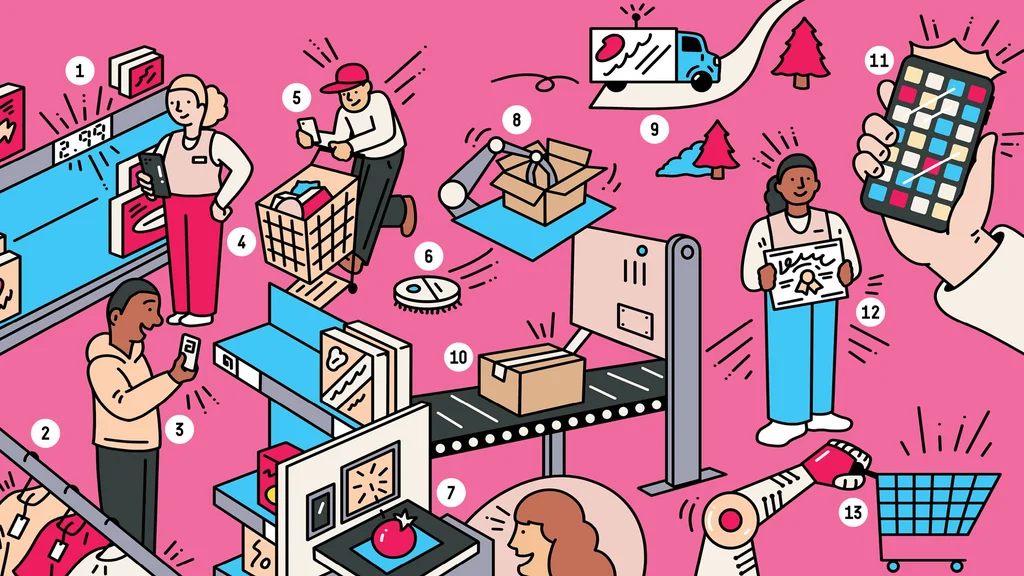
1. Electronic price tags have replaced paper tags, letting Walmart reprice an entire store in 30 seconds.
2. RFID chips on garments alert associates the instant a rack needs to be restocked.
3. QR codes on shelves let shoppers order out-of-stock items for home delivery.
4. Custom-configured Google Pixel phones help associates locate items and answer customer questions in dozens of languages.
5. AI-generated picking routes let online-order pickers follow an optimized path through the store.
6. Floor-scrubbing robots assist with cleaning.
7. Computer vision at self-checkout can price produce automatically.
Distribution and Delivery:
8. Custom box-building machines create cardboard boxes to an order’s exact dimensions.
9. AI truck routing and delivery time-prediction tech forecast when a driver will reach a store and how long grocery picking will take.
10. Automated box taping is a stop on the conveyor system.
Internal Tools and Training
11. The Code Puppy vibe-coding tool has produced hundreds of apps.
12. ChatGPT and Gemini certification courses are available to associates.
13. A consolidated operating system for e-commerce, grocery, forecasting, routing, and more is now infused with AI.
[Illustration: Sam Island]
Some 21 miles of conveyor belt twist and turn above and below me at Walmart’s highest-tech distribution center in Lancaster, Texas, 40 miles south of Dallas. Coursing quietly on them are millions of products in brown cardboard boxes, trucked in from suppliers across the country and getting ready to be sent back out as soon as a customer orders them.
While Walmart’s stores, sitting minutes from where people live, can rapidly deliver urgently needed items—diapers, prescriptions, dinner ingredients—its 164 distribution centers, spaced to blanket the country, ship things that can wait a day: pillows, bleach, clothing.
In this building, which is the size of 26 football fields, there is almost no one in sight. Spread 1,500 workers across 1.5 million square feet, and you can walk long stretches without passing a single human being. One of them, Faith Williams, is unboxing microfiber mops and putting them into plastic tote bins. Each bin is tagged with a bar code before the belt whizzes it off to the storage section in the back, where it’s stacked 35 bins high. In less high-tech distribution centers, workers can walk miles each day moving products around. But here, employees are stationed in one spot, which is less physically taxing. “We’ve organized this facility so that goods travel to the person, not the other way around,” says Barat Smith, VP of Walmart’s next-gen automation.
The instant a customer in the region clicks “buy,” the system cranks into gear, locating the product, pulling the bin from storage, and delivering it to a packer. When I reach Carlos Alva Cano, an employee, he’s taking a pink polo and a pack of razors from their bins and putting them in a box that was custom built to reduce waste. Once the order is ready, Cano hits the green button, and the box continues down the conveyor belt, where it’s taped shut and steered to a truck.
Walmart announced it was building this next-generation facility in 2021 as part of a sweeping plan to bring automation to its supply chain, which includes regional distribution centers, fulfillment centers inside stores, and autonomous vehicles for the last mile. Five years later, Walmart has four facilities like it, with another about to go live in California. Roughly 60% of Walmart’s online orders will soon be shipped out of these five locations, reaching 95% of Americans within a one- or two-day delivery window.
Amazon may have had the head start in e-commerce, but Furner is betting that Walmart has an edge Amazon can’t replicate: more than 5,200 U.S. stores that double as local fulfillment hubs, close enough to ferry groceries to customers faster than Amazon can from its network of 1,300 distribution centers. Walmart says it can now reach 60% of the U.S. population in half an hour, and 95% in under three hours. Meanwhile, Amazon, which measures itself in cities rather than population, offers 30-minute delivery in roughly a dozen metros and three-hour delivery in about 2,000 towns.
Walmart’s delivery efficiency—paired with the company’s broader push to woo higher-income shoppers with trendier styles and higher-end brands—has helped to reshape who shops at Walmart. For most of its 65-year history, the company’s core customer was lower-income and rural Americans—and by many measures, it still is. Walmart captures a quarter of every dollar spent through the federal food-stamp program, and more than 90% of SNAP households shop there. No retailer is more deeply woven into the lives of families struggling to feed themselves. However, the opposite end of the income ladder now drives Walmart’s growth. Walmart is poaching these shoppers from retailers that spent decades appealing to their tastes—Whole Foods, Trader Joe’s, Target—and from Amazon, which trained them to expect their orders ever faster, the standard collapsing from two days to two hours.
In 2020, Walmart took direct aim at Prime with its own membership program, Walmart+. Deepak Maini—the SVP of Walmart+, who came from Amazon—says the company has steadily piled benefits onto the $98 annual membership: free same-day delivery from your local store, free shipping from Walmart’s site, streaming through Paramount+ or Peacock, fuel savings at the pump. Walmart’s membership fee hasn’t budged even as Prime’s has climbed to $139 a year.
Walmart is now aiming to outmaneuver Amazon on digital execution. In June 2025, Walmart released Sparky, its answer to Rufus, Amazon’s chatbot—which the tech giant killed off in May 2026, incorporating the technology into Alexa for Shopping. Sparky began as a slightly improved search engine, but Daniel Danker, Walmart’s EVP of AI acceleration, says it’s growing more capable by the day. Recently, a customer uploaded a picture of some dying plants, and Sparky was able to recommend products to bring them back to life. Within the next year, Danker says that Sparky will be able to use its knowledge about you from previous conversations—that you make lasagna every week or are about to go on a trip—to recommend products.
Kumar says that Walmart is playing an entirely different game from Amazon. The e-commerce giant is increasingly focused on cloud services and has committed $200 billion on AI infrastructure this year alone, with a goal of reaching $600 billion in Amazon Web Services sales by 2036. Walmart, meanwhile, is monomaniacally focused on optimizing its stores and its website. The goal is to make the two feed into each other, nudging online shoppers into stores and coaxing lifelong in-store customers to try delivery. “Customers don’t care about online versus offline,” Kumar says. Win on both fronts, and Walmart isn’t just competing with Amazon for e-commerce—it stands to dominate the whole of retail.
Rosemary, a 67-year-old associate, has spent the better part of two decades working at the same Walmart Supercenter in Florida. She started as a cashier in 2006, climbing to department manager and then team lead. “I loved what I did, and I kept moving up,” she recalls.
After her daughter died five years ago, she stepped away for a year and a half, then came back as a part-time associate. This time around, Rosemary says the work feels different. She used to enjoy the process of manually changing prices, but her store just got electronic shelf labels, and the task vanished. She reports seeing fewer associates helping customers in the apparel and general merchandise departments, but many more filling online grocery orders. In the past, store managers would walk the floor and chat with associates, but these days, she rarely sees hers. Now, nearly everything runs through a screen, from job training to requesting shift changes. “You do everything online,” she says. “There’s no human contact.” (Rosemary spoke to Fast Company on the condition that her last name be withheld, citing concern about how it might affect her employment prospects.)
Rosemary is not alone in feeling that technology is making her job more soulless. “Workers report a loss of autonomy and a feeling of greater surveillance,” says Daniel Schneider, professor at the Harvard Kennedy School and codirector of the Shift Project, of the quarter of a million hourly workers at Walmart and other companies that his organization has surveyed over the last decade. “It seems like these technologies are being deployed in ways that degrade the quality, not just the quantity, of the work.” (“The feedback we hear from most associates is the opposite,” a Walmart spokesperson said in a written statement, noting that more than 40,000 employees have enrolled in company-funded AI programs.)
There are now calls for Walmart to start measuring the effects of technology on workers, particularly since the company is rapidly deploying new tools. According to the Shift Project, Walmart workers reported a dramatic increase in their exposure to AI on the job between 2024 and 2025, from about 10% to more than 30%. At Walmart’s annual shareholder meeting in June, the nonprofit United for Respect filed a proposal asking the company to study the impact of AI, automation, and other advanced technology on its workforce and share a report with the public. The board voted it down by a 95% margin.
“Workers don’t see job loss as an imminent threat,” says Bianca Agustin, the codirector of United for Respect, which advocates for Walmart workers from the outside, since the company has repeatedly blocked employees’ efforts to unionize. “But human creativity and decision-making are taken out of the equation with these automated task-management systems.”
Walmart’s digital transformation carries high stakes for a company still trying to move past its identity as the poster child for the low-wage economy. In 2001, the average Walmart associate earned $8.23 an hour—about $13,861 a year, which was below the federal poverty line for a family of three. Economists found that the opening of a single Walmart in a county lowered average retail wages there by between 0.5% and 0.9%. By 2014, Walmart’s low wages cost taxpayers $6.2 billion a year in food stamps, Medicaid, and subsidized housing.
When he became CEO in 2014, McMillon inherited a company that had endured six straight quarters of flat or negative U.S. sales. To reignite growth, he focused on fixing Walmart’s labor issues. A year into his tenure, he raised Walmart’s starting wage to $9 an hour—the largest private-sector raise in history at the time, lifting the pay of nearly half its million-plus U.S. hourly workers. Wall Street recoiled, with investors sending the stock down 10%, erasing $21.5 billion in market value in hours. But McMillon kept pumping money into wages and benefits—a move his own CFO later quantified at $2.7 billion over two years.
A decade on, the wage hike is taught at Harvard Business School as a success case. Walmart’s U.S. hourly wages have since risen more than 90% over the past decade, with an average wage today around $18. Even Walmart’s sharpest critics acknowledge that McMillon improved the lives of workers. “He deserves an enormous amount of credit,” says Agustin. “He genuinely listened to and absorbed the criticism.”
Under Furner, the reputation Walmart spent a decade rebuilding meets a new test in AI. According to the Shift Project, hourly workers report much more anxiety when their stores adopt AI tools. “There’s a clear connection between exposure to these new technologies and fear of job loss,” says Schneider. Furner tries to alleviate these concerns by arguing that as Walmart gains market share and revenue, it will maintain a large workforce even as technology makes each worker more efficient. “The business is growing,” he says. Walmart may need fewer workers to do the same amount of work, but the sheer amount of work will increase and with it, Furner says, will come “a lot of opportunity.” His corporate talking points may not reassure workers.
Donna Morris, the chief people officer, insists that the company isn’t planning any tech-related layoffs. As an example of how the company is preserving jobs, she points to distribution centers, which now require fewer workers because of automation. The company has moved those displaced workers into new roles in stores, pharmacies, and maintenance. “We planned for it,” Morris says. “Can we guarantee anyone that their job is going to look the same? Absolutely not. One of the constants at Walmart is change.”
Furner knows firsthand how much there is to learn as an associate. He had to figure out the ropes himself some 30 years ago, ringing up customers and pruning the plants at that Walmart garden center. Today, the job has only grown more complex, but Furner believes that this new generation of employees would be “running circles around what I was doing because the tools and the technology are so much better.” Speed, to Furner, is paramount—it defines how we shop and how associates work.
On my way home, I got to see one final time what Walmart’s obsession with speed can deliver. After spending five days talking to Walmart executives and employees at Associates Week, my flight out of Arkansas was delayed. I ended up arriving home a full day late. But the denim shorts I had ordered from the floor of the Fayetteville Supercenter were already sitting on my doorstep, right on time.
investment News

