King Charles to host AI chiefs amid industry call to slow development

The four-box test that tells you if AI is coming for your job
- Investment Opportunities Markets
 Peter Lynch
- 9 minutes read
I teach a class at London Business School about technology and work. I use an exercise with my students that shows how technology will impact our work.
First, write down the tasks you perform in a normal week. Most of us have around 30. This matters because technology rarely replaces an entire job. It replaces specific tasks. You need to know which ones.
Next, ask two questions about each task. Is it routine or nonroutine? And is it manual or cognitive? Line those up and that gives you four categories, and each one tells a different story about your future.
First, you will discover some of your tasks are routine; you could describe them to someone with ease. Others are nonroutine; they are more complex and not easily described or done. Look at your list of tasks and make a mark against any that are routine or nonroutine.
The second dimension describes the human nature of the task. Some are manual; you use your muscles to accomplish them. Look at your list of tasks and make a mark against any that are manual.
Some tasks are cognitive; you use your brain. Much of my current job is cognitive—analyzing data, writing reports, teaching a class, thinking through the structure of ideas to write a newspaper article or a book. What are the cognitive tasks you perform?
Now you have put these two dimensions together; you’ve created four categories of the tasks you perform. Let’s take a closer look at each category and the impact on work:
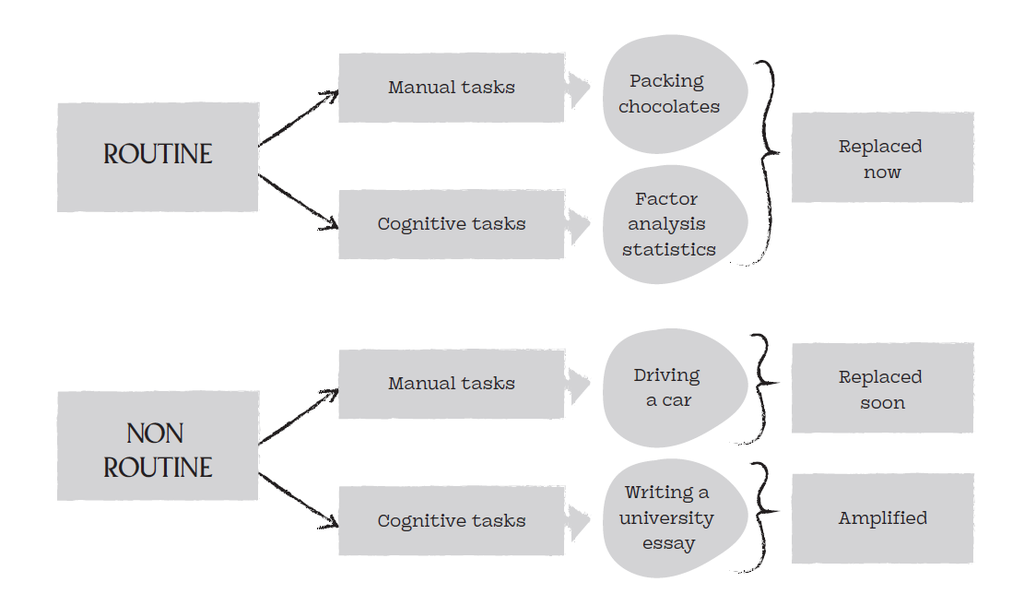
Routine/Manual Tasks – like packing chocolates
The example I give is of the task I performed in 1970. A manual/routine task, packing chocolates by hand on a moving conveyer belt. Over the 1980s this task became entirely automated. In the following decades, many other routine tasks were automated: packing, metal pressing, welding, even operating forklifts. You can assume that any routine manual tasks you perform will be completely automated in the future.
Routine/Cognitive Tasks – like factor analysis statistics
The example I’ve used is the factor analysis statistics I performed in 1980 on the university mainframe computer. While this machine looked futuristic, it was essentially performing routine work—in this case, statistical analysis. The output might seem complex, yet any trained statistics student could have followed the same steps manually. The key difference was speed and accuracy. What might have taken me days could now be completed in hours.
The assembly line replaced hands, the computer replaced brains—but only for routine tasks that could be broken into clear, repeatable steps. And it turns out there are many such tasks, something discovered by spreadsheet assistants and bank tellers whose roles were later digitized. So, you should expect that any routine/cognitive tasks in your list will be automated and replaced.
Nonroutine/Manual Tasks – like driving a car
Nonroutine manual tasks like driving a car, sorting laundry, or plumbing a house were once expected to be the frontier of automation. When I wrote in 2010 about the future of work in The Shift, the technologists I consulted predicted that by 2025, we’d see fleets of driverless cars and even robotic plumbers.
The rollout of driverless cars has been far slower than expected, slowed by safety regulation and high costs.
But this is not the whole picture. In San Francisco, you can ride in a driverless Waymo taxi—astonishing at first, then quickly normal. In China and the U.S., billions are flowing into robotics startups, with companies like Figure AI building humanoid robots designed for flexible, general purpose work. Uber and others are experimenting with robotic solutions, betting that today’s constraints will give way to breakthroughs.
Predictions are often both wrong and right: slower in some places, faster in others. What looks impossible in one city is already routine in another. That is why technological forecasting is so hard. Some changes creep forward, others arrive suddenly and with force—like social media and generative AI.
Nonroutine/ Cognitive Tasks – like writing a university essay
My third story of ChatGPT showed a technology augmenting and, in some cases, replacing complex, nonroutine cognitive tasks like writing a university essay. Unlike earlier technologies that automated predictable, codified processes, this wave, beginning in 2023, felt startlingly human. It didn’t look human, of course, but it could do things we once believed only humans could: write, analyze, summarize, create. This wasn’t rule-following anymore. The engine behind it was a large language model, trained not on fixed logic but the vast ocean of human knowledge and expression.
What struck me most was the moment I realised why ChatGPT could respond to the prompt, “‘Write an essay like Lynda Gratton.” It could do this because it had ingested much of my writing: books, articles, blogs. Without my permission, but with astonishing fluency. That revelation—that so much of ourselves is already in the machine—was both deeply unsettling and deeply impressive.
Equally striking was the rise of artificial intelligence in counseling and coaching. By 2024, one of the largest reported uses of generative AI was in therapy and mental health support. People turned to chatbots not because they believed the machine truly cared, but because it was always available and nonjudgmental, and—ironically—sometimes seemed more empathic than humans. In workplaces, AI “coaches” were deployed to help employees prepare for performance reviews, to simulate difficult conversations, even to suggest personalized learning paths. Coaching and counseling, once the most human of professions, were suddenly being reshaped.
That leaves the crucial question: When these tools take away chunks of what once felt uniquely ours, what remains?
What’s Left for Humans?
When you step back from these categories—routine and nonroutine, manual and cognitive—you see a stark truth: Most tasks are, sooner or later, touched by technology. Some are automated quickly. Others take decades. But few remain untouched forever.
That raises the most urgent question: What’s left for humans?
The answer is not a single skill or occupation, but a stance. The real challenge is to build resilience, the capacity to continually reassess your value as technology advances. In earlier decades, you might have done this once every 10 years when a new platform or process appeared. Now the cadence is accelerating. AI models update monthly, sometimes weekly. The ground under your working life is constantly shifting
So, what remains human is not simply the task list, but the practice of reflection. Knowing how to ask: What do I bring that no tool can? What questions do I ask that others overlook? What perspectives do I hold that machines cannot imitate?
This is where distinctly human capacities—curiosity, empathy, judgment, imagination—become more important, not less. As machines grow more fluent, our unique value lies not in matching their scale, but in deepening our difference.
Excerpted from Living the 100-Year Life by Lynda Gratton, run with permission of the author, courtesy of Bloomsbury Continuum, an imprint of Bloomsbury Publishing Plc. © Lynda Gratton, 2026
investment News

