Ethereum Price Target $2k as ETFs Record Biggest Weekly Inflow in Nearly Four Months

Terafab could become the largest factory on the planet—or Elon Musk’s biggest failure
- Investment Opportunities Markets
 Peter Lynch
- 8 minutes read
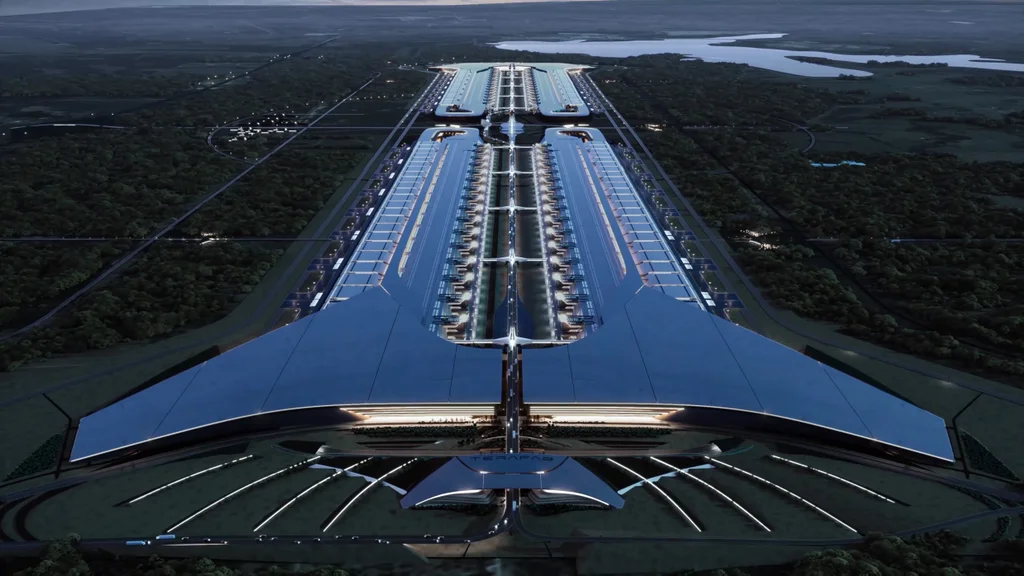
At last, we know how Elon Musk’s fabled Terafab will look. Tesla and SpaceX showed a video rendering of their jointly developed advanced chip factory on Thursday. It will occupy 100 million square feet in Grimes County, Texas, about 45 miles northwest of downtown Houston. The sci-fi-looking building is so vast that you could fit six of them in Manhattan. Musk, the CEO of both companies, took to X on Thursday to declare it “the largest and most valuable building on Earth by far.”
Except, you know, it doesn’t actually exist. As with so many of Musk’s grand projects, like the ones he used to sell his inflated SpaceX IPO, this is just a megacool gigafuturistic terarender.
Musk’s brand is the epic announcement, and the Terafab launch does not disappoint in that regard. The factory’s website labels itself as “the most epic chip-building effort ever.” It is a cosmic vision, sold as imminent, wrapped in renderings.
The question isn’t whether Terafab will ever be real; it’s whether it will be this Terafab, on this schedule, at this size.
What is Terafab, exactly?
SpaceX says the facility will be “an advanced semiconductor fab that will bridge the divide between current global chip supply and the compute demand of the future.” A vertically integrated factory putting manufacturing, packaging, and testing of advanced logic and memory under one roof, the company claims “Terafab will be epic in both its mission and in its sheer size.”
The chips will be optimized for edge computing and inference, destined for Tesla’s Optimus robots and self-driving Cybercabs, while additional high-power chips will sustain SpaceX’s space-based data centers. Intel is participating, though Intel won’t say what its role is. SpaceX promises to employ at least 3,000 workers from Grimes and neighboring Brazos counties, and says it’s “committing to the use of” water from the local Gibbons Creek Reservoir rather than local groundwater.
According to Bloomberg, the fab (semiconductor fabrication plant) will be powered by natural gas power plants that SpaceX will build itself. “We are bringing our own power,” Riley Trettel, SpaceX’s head of energy and data center development, told residents at a public meeting Wednesday—plus “very large battery arrays.” Solar power is nowhere in the plans, even though project partner Tesla is itself a solar manufacturer.
SpaceX, freshly public after raising $87.5 billion in its IPO, got a 100% tax abatement from Grimes County—contingent on spending at least $5 billion by 2030 and creating at least 1,800 full-time jobs by 2035—plus $30 million in state incentives. The news landed one day after hundreds of residents packed a county meeting Wednesday to protest those millions in tax breaks and what they saw as insufficient transparency.
The Texas Governor’s office put out a statement endorsing the deal from Dr. Sarah Borowicz, superintendent of the Anderson-Shiro Consolidated Independent School District, promising every opportunity would be managed “wisely, transparently, and always with students at the center of every decision.”
Still, the price keeps shifting. Terafab was unveiled in March as a $25 billion factory, then slated at $55 billion in later filings, and is now budgeted at $16.8 billion for its first phase—with filings suggesting the total bill could reach $119 billion across a “multi-phase” construction plan. Same factory, third price tag.
Terafab, it’s worth noting, did not come up on SpaceX’s first earnings call earlier this week.
Size matters
Putting aside its fantastic ambitions and potential conflicts with the interests of Texas residents, one can only be amazed at Terafab’s theoretical final size. Apple Park, the “spaceship” complex in Cupertino, California, is roughly 2.8 million square feet. Tesla’s Gigafactory Texas facility, already one of the largest buildings in the world, is about 10 million square feet. At 100 million square feet, Terafab would be 10 Gigafactory Texases and 35 Apple Parks.
Back in March, Musk said Terafab was going to be as big as 15 Pentagons. Yesterday, Musk was posting that Terafab “will be 50 times the size of the Pentagon when complete.” Either way, it’s massive.
This otherworldly footprint mirrors Musk’s other supersize ambitions, which include launching 1 million AI servers into orbit and establishing a 100-gigawatt space data center, fed by a factory on the moon that would catapult the servers into Earth’s orbit using an electromagnetic mass driver. Back then, experts in physics, aerospace engineering, and chip design pointed out that Musk’s plan ignores basic thermodynamics. Of the lunar factory and its mass driver, Harvard astrophysicist Avi Loeb said: “The entire project sounds more like a speculative science fantasy than a believable technological project.”
Terafab feels like the terrestrial mirror of that space fantasy. Ironically, among its planned output are the high-power chips designed to run SpaceX’s space-based data centers.
Musk will keep selling the future in units of epic. Epic in mission and epic in sheer size. Maybe Grimes County gets its 3,000 jobs and its robot chip factory. Or maybe it gets a very large, very tax-exempt construction site and a hard lesson: The rendering is always the biggest version the building will ever be.
investment News

