Europe’s Fortune 500 2026: Record revenue, shrinking margins, and a new No. 1 country

Karin Rådström is steering Daimler Truck in a new direction as the world’s biggest truckmaker faces a growing challenge from China
- Investment Opportunities Markets
 Peter Lynch
- 12 minutes read
Karin Rådström is used to being the only woman in the room. She was the first to lead Scania’s bus and coach division, having worked her way through the ranks from marketing trainee to head of sales and marketing and executive vice president at the Swedish truck manufacturer.
Now, as CEO of Daimler Truck, she heads up the world’s largest manufacturer of commercial vehicles. Rådström became only the second woman to lead a company in the DAX 40 upon her appointment in 2024 and is one of only 43 women CEOs in the Fortune 500 Europe. “I try to use that as a positive motivation more than a heavy burden,” she says. “The best way to increase the number of leadership opportunities for women is, of course, to be successful.”
Since Rådström became CEO, Daimler Truck’s share price has increased almost 40%, from €33.15 to €46.24, and she has overseen significant growth in the company’s zero- emissions vehicle sales, which rose 67% in 2025. But this success has not come easily. Rådström reels off a lengthy list of headwinds: supply-chain challenges, semiconductor shortages, the war in Ukraine, geopolitical issues, and tariffs in the U.S. “It’s been kind of a ride,” she says.
Changing gear
Despite only recently becoming an independent business (formed out of the split of Daimler AG into Mercedes-Benz and Daimler Truck in 2021), Daimler Truck has over a century of history. This year marks 130 years since German engineer Gottlieb Daimler built the very first motorized truck, basing his design on a horse-drawn carriage.
Rådström, a Swede, was surprised by the layers of hierarchy at the German company and the sheer volume of decisions that crossed her desk as CEO. In one of her first meetings, she was asked to look at the designs for a new truck cab and formally approve it. Important decisions were often accompanied by a lengthy slide deck. “Those things don’t work in the changing environment that we have now,” she says.
72
Daimler truck’s rank on fortune 500 europe

Rådström has called on the company to operate “simpler, faster, and stronger.” This mantra, which encourages quicker decision-making and greater autonomy, has been central to the cultural transformation that she has spearheaded since becoming CEO. “You never have 100% of the information you’d like,” she says, “so if you don’t decide, you might miss big opportunities.”
Those familiar with Rådström’s leadership style describe her as authentic, strategic, and inclusive. One friend, Charlotte Berg, a consult service director for IT company Kyndryl, first met Rådström at a professional development program run by the Stockholm-based Women for Leaders, and Rådström suggested that they go for a run together. Keeping up with Rådström, a former rower for the Swedish national team, was a challenge, Berg says, but the two became fast friends. To this day, they exchange notes at the end of the workweek on what happened, their feelings, and any lessons learned.
The cultural transformation led by Rådström at Daimler Truck has not gone unnoticed. Klas Bergelind, managing director and industrial tech and mobility analyst at Citi, says Rådström has created a more decentralized organization and has encouraged staff to shed some of its more bureaucratic practices. But there’s still significant work to do, he adds: “Cultural change takes time, and while costs are gradually lowered, other temporary cost headwinds are weighing on results.”
Indeed, despite reporting a 5% uplift in revenue in its Q2 financial results, net profits for the group dropped 48% com- pared with the same period last year. Profitability was primarily impacted by tariffs, but earlier-announced price increases and a more favorable tariff arrangement with the U.S. are expected to boost earnings the rest of the year.
Chinese competition gains ground
Another headwind on the horizon is the challenge from China. For now, the European truck market is relatively secure, but the broader European automotive market is being buffeted by Chinese competition. Sales of Chinese electric cars in the Western European market hit a record high this year, accounting for 14.2% of purchases in the first five months of 2026, according to Schmidt Automotive Research, up from 3% in 2024. Meanwhile, the share of China’s car market that is occupied by foreign brands is in steep decline.
Put simply, Chinese EVs are just better than a lot of the competition, says Howard Yu, a professor of management and innovation at IMD Business School and codirector of the Future Readiness program, which evaluates global car manufacturers. In the Southeast Asian market, the technological superiority of many Chinese-made cars is making European produced vehicles appear outdated, Yu says. “It’s like listening to vinyl in the age of Spotify,” he says. “It’s viewed as cute and nostalgic.”
Daimler
European automakers are well aware of China’s technological advantages and Europe’s higher manufacturing and regulatory costs. In a joint letter to the European Parliament, Volkswagen, Stellantis, and Renault warned of an “unprecedented challenge to their competitiveness.”
So far, the European truck market has largely been insulated from the challenge from China. Chinese companies hold a marginal share of 1.36% in the European commercial-vehicle market, according to market research company Dataforce, and three of the four biggest companies in the industry, Daimler Truck, Volvo, and Traton, are headquartered in Europe.
However, the pressures facing the car industry could be a sign of things to come for the heavy-vehicle sector. Chinese truck companies have been expanding their market presence in Europe. SuperPanther and Sinotruk have both begun production in Austria, while Chinese-backed electric-truck manufacturer Windrose has established a European headquarters in Antwerp, Belgium. As with EVs, Chinese trucks are increasingly technologically advanced, says Thomas Fabian, chief commercial vehicles officer at the European Automobile Manufacturers’ Association. Windrose’s Global E700 truck has a fully loaded range of 700 km, for example, while Daimler Truck’s flagship model has a 500 km range. “They [Chinese companies] are at the doorstep, they’re coming,” Fabian says.
European truck manufacturers have some “moat” in their established relationships and service networks. While cost is an important factor, service reliability and the availability of spare parts are also important considerations for truck carriers, and overhauling an entire fleet is a major investment. But Rådström isn’t relying on that. “It’s on us to work on our competitiveness, stay on top of innovation, and remain strong on cost,” she says.
The European Commission’s requirement of a 40% reduction in emissions from new heavy-duty vehicles by 2030 also risks handing Chinese manufacturers an opening, according to Daniela Costa, Goldman Sachs’ head of European capital goods research. Only 2.4% of trucks operating in the EU in the first quarter of 2026 were zero-emissions vehicles. In contrast, one in four trucks sold in China in 2025 was electric, and the International Energy Agency estimates that China accounted for 90% of the 400,000 electric trucks sold globally last year.
Changes are needed for Europe to remain competitive, including better charging infrastructure, reduced bureaucracy, and faster decision-making, Rådström says: “Our customers run on tight margins, so they don’t have the time to experiment with new technologies. We have to show it can reduce costs.”
In it for the long haul
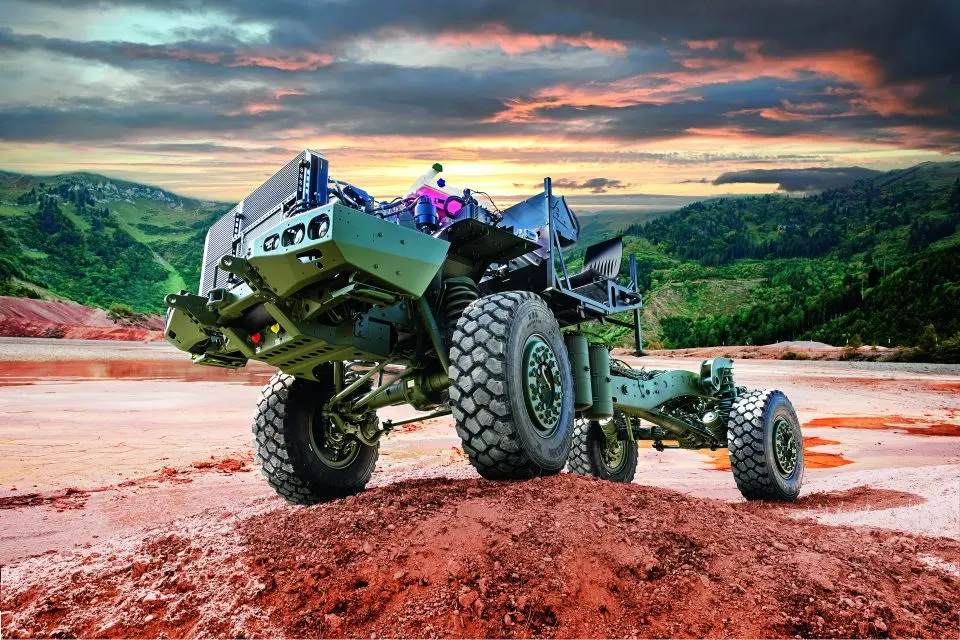
Defense has also been identified as a key pillar of Daimler Truck’s growth strategy. The company aims to double defense-related revenues to €1 billion ($1.17 billion) by 2028 and has plans to invest “mid-three-digit-million euros” in its newly established Daimler Truck Defence brand. “We have a very strong position because we are industrialized, so we have the opportunity to build a lot of volume, and we can leverage our civil side for defense applications,” Rådström says.
She also hopes that closer partnerships with startups in the military space will lead to innovations that can be translated to civilian vehicles—particularly in autonomous driving. Daimler Truck has ambitions to release Level 4 autonomous trucks—which can handle all driving tasks in most settings without human intervention—to the U.S. market by 2027.
While the involvement of European truck makers in the defense sector is not new, rising geopolitical tensions, increased government defense spending, and the ongoing war between Russia and Ukraine have presented new opportunities in this field. “Unfortunately [defense] is an important industry, which is growing,” she says. Over the past year, Daimler Truck has secured contracts with the German, French, Lithuanian, and Canadian armed forces. “A lot of the time it’s about defending democracy, and that’s not something that makes me sleep badly at night; rather, the opposite,” Rådström adds.
Although defense is one of the fastest-growing areas of Daimler Truck’s business, it is growing from a small base and is likely to remain small. If the company does achieve its €1 billion target, it would still represent only 2% of overall annual revenue.
Securing growth over the longer term will require further innovations as Rådström continues her turnaround program. “It’s about making our customers more satisfied; growing employee engagement, because that’s what makes us successful; and showing that we’re improving in the numbers,” she says.
Rådström remains acutely aware of the company’s 130 years of history. “It makes you realize—even if I stay in my role for 10 years— I’m still a pretty small part of the long history of this company,” she says. “So I try to stay humble and will aim to hand over an even better company than what was handed to me two years ago. That would make me really proud.”
For the latest coverage and updates from Fortune CEO Forum, as well as insights into the companies on our list, visit this page.
This article appears in the Fortune 500 Europe special edition with the headline “At the wheel of a 130-year-old giant”
investment News
Daimler,Fortune 500 CEO Interview,Fortune 500 Europe,Fortune CEO Forum,londonarticles,vehicles

