Trump Crypto Ethics Deal Fails to End CLARITY Act Objections

After $8.2B loss forced Bitcoin sales, Michael Saylor gives Strategy to September to repair broken dividend engine
- Cryptocurrency
 Crystal Kim
- 13 minutes read
Michael Saylor’s Strategy (formerly MicroStrategy) is targeting a September recovery for its STRC preferred stock as the company seeks to revive the financing channel behind its goal of doubling Bitcoin per MSTR share within seven years.
The plan follows a second quarter that demonstrated Strategy’s growing exposure to Bitcoin’s price swings.
The company reported an $8.22 billion second-quarter loss after earning $10.02 billion a year earlier. Almost all the reversal came from an $8.32 billion loss on its digital assets as Bitcoin ended June about 40% below its level at the end of last year’s second quarter.
Strategy continued buying through the downturn. Its holdings increased 11% during the quarter to 846,000 BTC, while Bitcoin per diluted share rose 5% to 210,824 satoshis.
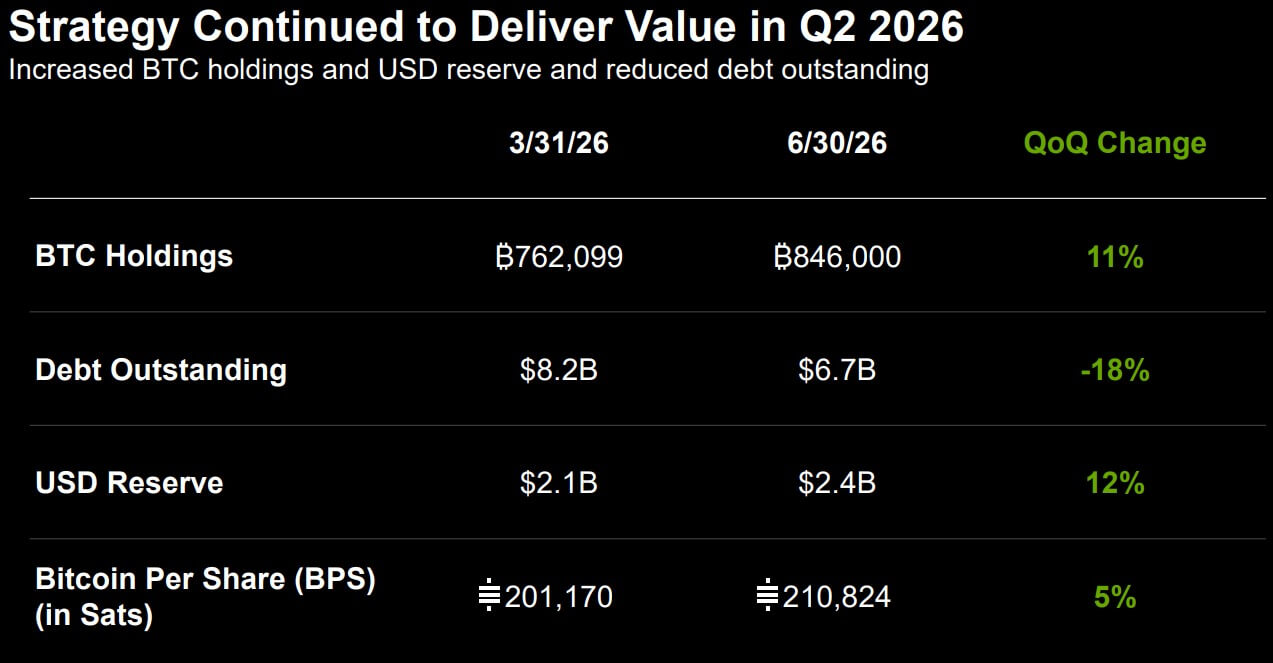
The company subsequently reduced its holdings to 843,775 BTC after selling selected coins to meet preferred-stock obligations. Bitcoin per share also declined to 203,683 satoshis by July 26.
Those sales remain small compared with Strategy’s acquisitions. The company bought 174,895 BTC and sold 3,620 BTC during the first seven months of 2026, meaning purchases exceeded disposals by more than 48 times.
STRC becomes central as institutional demand grows
The transactions nevertheless highlight how STRC has changed Strategy’s model. The preferred stock has given the company another way to finance Bitcoin purchases, but it has also created a growing cash burden that must be managed when markets weaken.
STRC’s stated value nearly doubled during the second quarter, rising from about $5.3 billion at the end of March to $10.5 billion by June 30.
Strategy raised $7.53 billion through the variable-rate perpetual preferred stock during the first seven months of the year, making it one of the company’s largest sources of new capital.
Its investor base also broadened. Institutional holdings nearly tripled to $3.1 billion between March 17 and July 1, increasing their share of STRC to 29% from 22%.
Retail investors remained dominant, holding $7.4 billion, or 71%, of the outstanding stock. The average retail position increased to $48,000 from $44,000, while the average institutional holding more than doubled to $3.5 million.
Saylor said:
“As of the 1st of July, the institutional holdings had grown from $1.1 billion to $3.1 billion.”
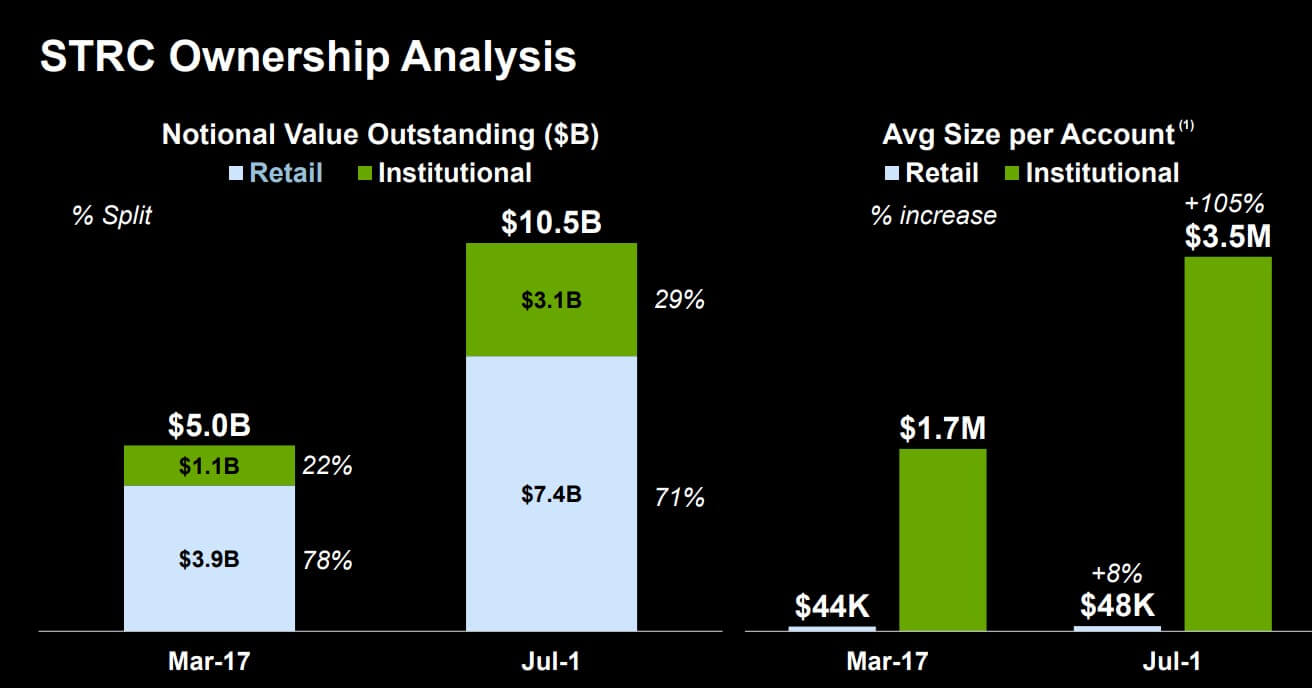
He argued that the shift should improve the security’s stability and help Strategy attract investors beyond the crypto market.
Strategy initially sees STRC competing with private credit, bank preferred stocks and high-yield bonds, with investment-grade and mortgage-backed securities representing longer-term markets.
Strategy uses September as its recovery benchmark
STRC’s effective yield stood at 13.6% in late July, reflecting its 12% dividend rate and discount to its $100 stated value. That discount made the product more attractive to income investors, but it also restricted Strategy’s ability to issue additional shares efficiently.
The shares fell to $74.57 on May 28 before recovering to about $89. Selling more STRC at that level would raise less cash than the $100 senior claim created against Strategy, weakening its usefulness as a Bitcoin financing tool.
Management attributed part of STRC’s decline to its decision to direct too much capital toward Bitcoin while allowing the cash reserve supporting its preferred securities to shrink.
Strategy’s designated dollar reserve fell to $871 million in late May, covering only about six months of preferred dividends and debt interest. The company has since rebuilt it to $3.75 billion, extending estimated coverage to 2.1 years.
Chief Executive Phong Le said the experience forced Strategy to reconsider how it balances Bitcoin purchases with the liquidity needed to support STRC.
Strategy plans to maintain STRC’s dividend rate at 12% after concluding that further increases were unlikely to restore the price. Its recovery plan now relies on the larger dollar reserve and open-market repurchases.
The company authorized $1 billion of preferred-stock buybacks and spent $25 million acquiring STRC shares. It has $975 million remaining under the program.
Those measures have also given Strategy a timetable against which investors can judge the repair effort.
The company is tracking September 8 as an informal benchmark for returning STRC to par, based on the 70 trading days the security required to climb from its $90 offering price to $100 after its July 2025 launch. Applying the same period from the May 28 decline produces the September date.
Saylor said:
“We’re keeping track of that date, and we’re keeping track of our progress. If we did it in 70 days after the IPO, then it’s reasonable to target 70 days after it fell off of our trading range.”
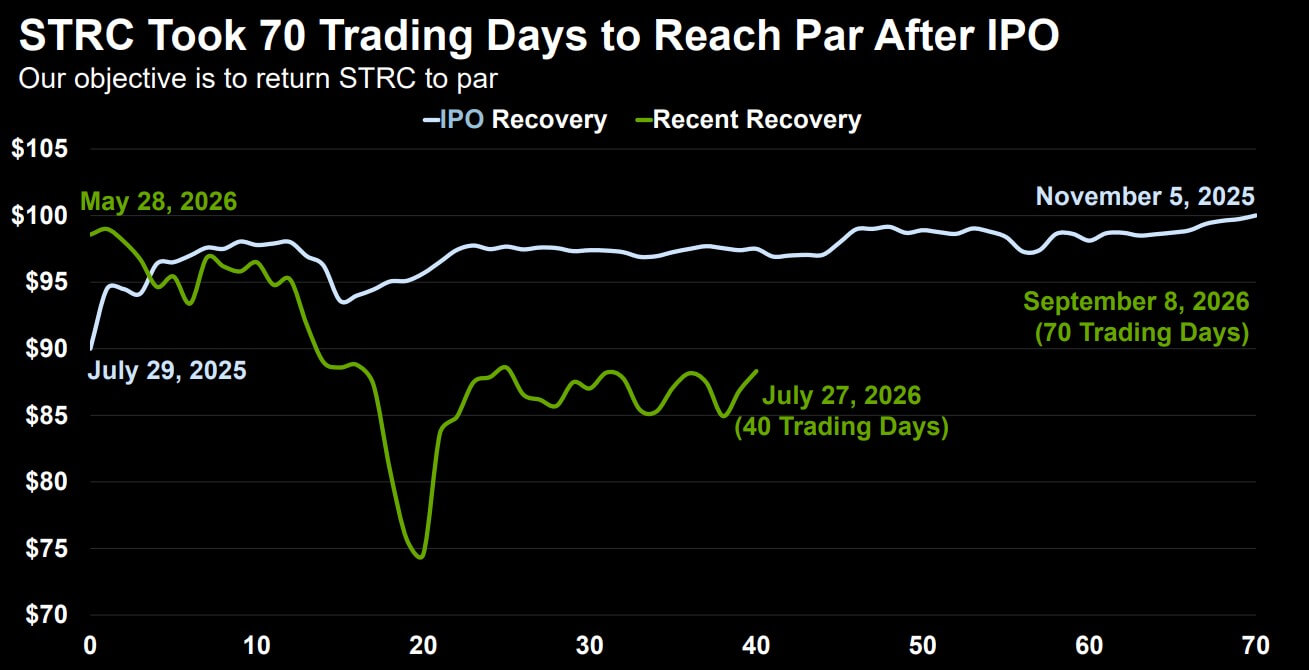
The comparison does not guarantee another 70-day recovery. STRC’s initial rise occurred under different market conditions, and Strategy cannot compel investors to value the stock at $100.
The scale of the current discount also suggests that the repair may require more intervention.
Saylor placed STRC’s market capitalization at $9.2 billion against $10.5 billion of stated value, leaving a gap of about $1.2 billion.
While Strategy would not need to purchase the full difference if stronger demand lifts the shares, the remaining authorization is smaller than the quoted dislocation.
Still, Saylor insisted that the firm has “the means to return STRC to par,” citing its $58.5 billion Bitcoin reserve.
This suggests that support beyond the current authorization could require further Bitcoin sales, new securities issuance, or capital that might otherwise fund accumulation.
STRC recovery underpins Strategy’s 2033 target
Returning STRC to par would allow Strategy to resume issuing the preferred stock at terms that support its longer-term Bitcoin strategy.
Le said:
“Our overall objective is to double Bitcoin per share in seven years through digital credit.”
The target implies growth of roughly 10% annually through 2033 in the amount of Bitcoin represented by each diluted MSTR share.
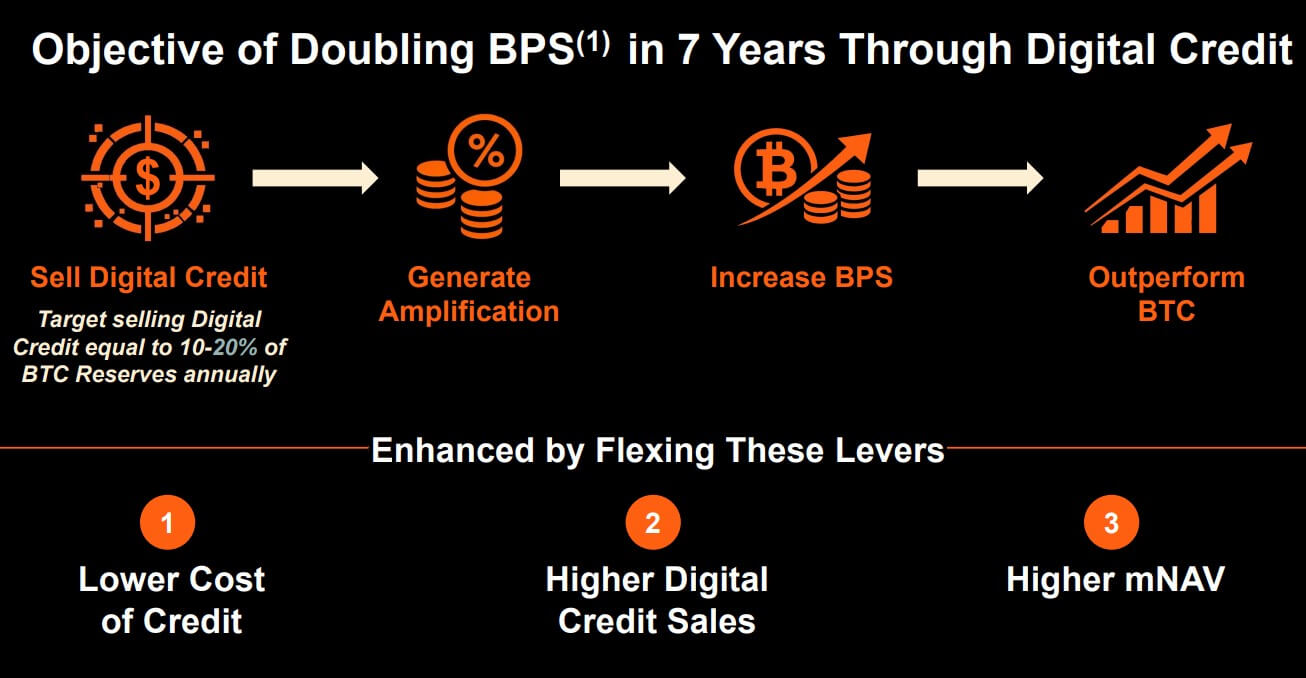
To achieve this, the company plans to issue STRC and other preferred securities, retain part of the proceeds in its dollar reserve, and use the remainder to buy Bitcoin without producing the same immediate dilution as an MSTR sale.
At the same time, Strategy wants annual digital-credit sales to equal between 10% and 20% of its Bitcoin reserve. Based on the roughly $55 billion portfolio cited in its results, that could amount to between $5.5 billion and $11 billion of issuance each year at current values.
Le said:
“We want digital credit to work because we’re able to sell digital credit to buy Bitcoin. That generates amplification to the company.”
Cryptocurrency News
Bitcoin,MSTR,Saylor,Strategy,STRC

