3 guys using Anthropic’s Claude hacked into OpenAI and accessed its source code for $6,500 reward

7 ads that define ‘The New York Times’
- Investment Opportunities Markets
 Peter Lynch
- 6 minutes read
This week, The New York Times is celebrating the 175 anniversary of its founding on September 18, 1851. To commemorate the major milestone, the publication is paying tribute to one of the institutions that’s kept its journalism running for almost two centuries: advertisers.
The campaign’s centerpiece is a nine-page print spread featuring seven real ads from The New York Times’s massive archives, dating all the way back to its inaugural year. It also includes a landing page on the NYT’s Advertising homepage with a timeline of the key moments, digital ads across the publication’s various verticals, and audio spots on its podcasts.
It arrives at a challenging time for publishers, who, in the era of zero-click search and declining print ads, are reevaluating their business models. In its earnings report for the second quarter of 2026, the NYT stated that its print advertising revenues decreased 11.1% while its digital advertising revenues rose 20.7% compared to the second quarter of 2025.
For the NYT, the campaign serves as a key moment to publicly recognize the contributions of its advertisers. But it also reflects an interesting pattern: each asset featured in the campaign shows how advertising is often one step ahead of the next societal shift.
“What we found was, over time, advertising actually reflected the cultural moments that we were reporting on,” says Tusar Barik, SVP of marketing for New York Times Advertising.
7 ads to define The Times
The idea for the commemorative campaign started when Barik took his team on a tour of the NYT physical archives, located three floors underground in a building next to the publication’s office. He says the room is filled with “millions of pages of printouts.”
At first, he imagined a project that would illustrate how extensively advertising formats have changed—from the long, tightly packed chunks of flowery text in the late 1800s to editorial photography in the ‘60s and, today, digital assets, video, and more. But as he looked more closely at the ads themselves, he found something even more interesting: the social trends they augured.
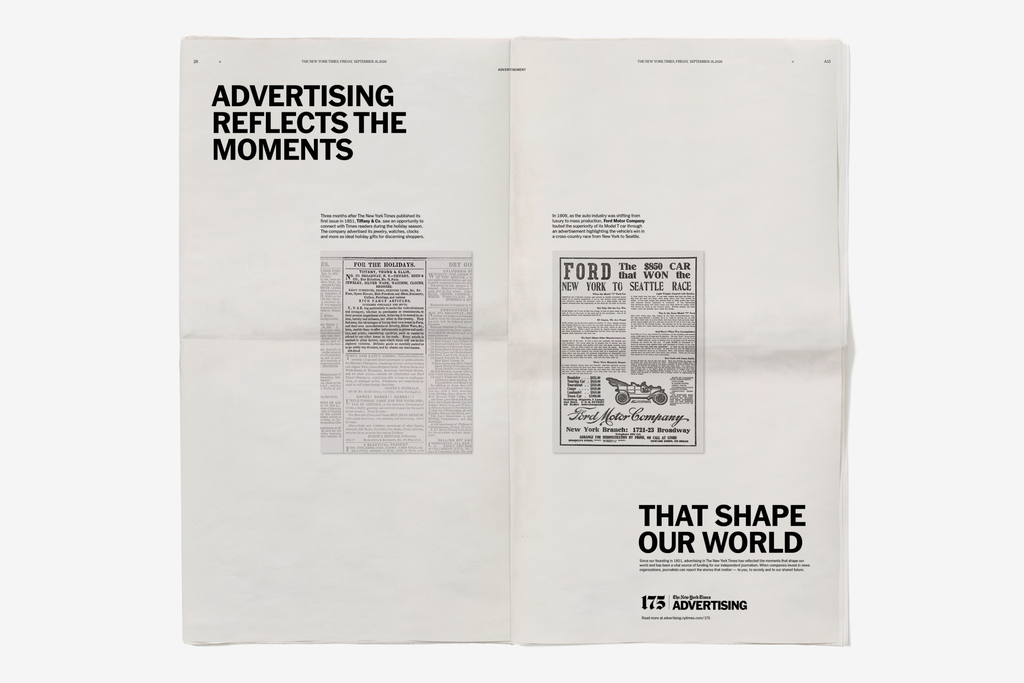
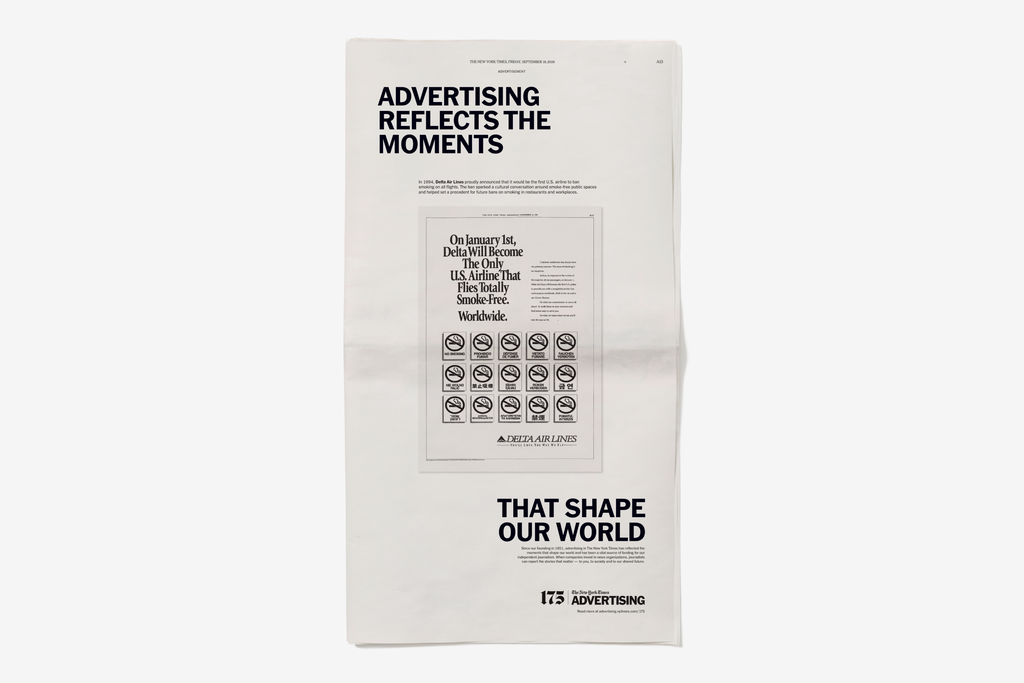
In 1909, Ford took out an ad in the NYT to highlight its Model T as “the $850 car that won the New York to Seattle race.” At the time, the auto industry was just shifting from luxury to mass production. In 1966, IBM bought ad space to run a large picture of the moon, promoting its involvement in “helping the NASA team put a man on the moon.” Three years later, that mission was complete. And in 1994, Delta Air Lines used the NYT to proudly declare its plan to “become the only U.S. airline that flies totally smoke free,” helping to spark a widening cultural conversation around banning smoking in public spaces.
To create the final campaign assets, Barik’s team selected the best examples of design and cultural relevance out of thousands of potential options, while also choosing companies that still exist today—a tricky feat, given how many advertisers either no longer exist or have been subsumed into other companies over the years. All seven of the final companies (Tiffany & Co., Ford, Heinz, IBM, Delta, E*Trade, and L’Oréal) gave their consent to be included in the project, and none were charged a fee.
Barik hopes that the final product will remind readers how “fundamentally important” advertisers are for independent journalism—and how advertising itself is a form of historical documentation.
“We had this really great opportunity to showcase, in all these different moments, how, whatever was happening in the world, advertisers were also part of that,” Barik says. “Just like the news is telling the story of the world, advertising is telling a portion of that story.”
investment News

