

Key Takeaways
- Trump and Senate leaders are pushing the CLARITY Act ahead of the August recess amid growing legislative urgency.
- Claude argues XRP stands to benefit more than Bitcoin (BTC) or Ether (ETH) if the CLARITY Act becomes law.
- The White House Crypto Council will transition leadership as Patrick Witt begins military leave later this month.
- The bill would divide crypto oversight between the SEC and CFTC, creating the first comprehensive US market structure framework.
As the Senate hurtles toward a potential floor vote before the August recess, the long-awaited Digital Asset Market Clarity Act (CLARITY Act) stands at a pivotal crossroads.
With President Donald Trump publicly urging its passage in honor of the late Sen. Lindsey Graham, lawmakers face mounting pressure to deliver the first comprehensive US framework for crypto markets or risk watching innovation flee overseas.
The bill, which cleared the House with strong bipartisan support in July 2025 and advanced out of the Senate Banking Committee in May 2026, aims to end years of regulatory uncertainty by dividing oversight between the SEC and CFTC while introducing consumer protections and innovation safeguards.
Senate Races Against the August 7 Deadline
Negotiations have intensified in recent weeks, with Senate leaders racing against the August 7 deadline. Sen. Cynthia Lummis has warned that failure to act could mark the last realistic shot at meaningful crypto legislation this decade, potentially costing American jobs and ceding ground to global competitors.
The momentum builds on the House’s 294-134 vote last summer and the committee’s 15-9 advance, which included Democratic support. Proponents highlight the bill’s potential to replace the SEC’s “regulation by enforcement” approach with clear rules for exchanges, brokers, and digital asset classifications.
President Trump’s call to action, tying the legislation to Graham’s legacy, has injected fresh urgency into the debate.
Yet time is tight. Behind closed doors, negotiators are hammering out compromises on lingering issues, including stablecoin provisions and ethics rules aimed at preventing conflicts of interest for officials involved in crypto ventures.
What the CLARITY Act Would Actually Change
At its core, the legislation draws a “bright line” between digital assets treated as securities (under SEC purview) and those functioning as commodities on decentralized networks (falling to the CFTC).
It introduces a new “Regulation Crypto” exemption to help projects raise capital with tailored disclosures, offers safe harbors for DeFi developers and validators, and includes provisions addressing tokens that evolve from investment contracts to commodities.
Additional measures target consumer protections, ban certain high-risk activities like memecoin facilitation by registered entities in some drafts, and push back against central bank digital currencies. Industry advocates argue this clarity would unlock institutional participation, stabilize markets, and position the US as a global leader in blockchain technology.
Critics, including Sen. Elizabeth Warren, counter that the bill lacks sufficient guardrails against corruption and could expose everyday investors to undue risks without stronger oversight.
Why XRP Could Be the Biggest Winner if the CLARITY Act Passes, per Claude
According to Claude, XRP benefits most from CLARITY Act passage, and the reasoning is structural rather than speculative.
Here is why, asset by asset.
Bitcoin benefits from CLARITY Act passage, but it does not need it the way the other two do. Bitcoin already has commodity status under existing CFTC guidance, the SEC has never seriously contested it, and spot ETFs are already approved and trading.
The CLARITY Act would accelerate institutional inflows and Citi’s $143,000 target is contingent on it, but Bitcoin’s legal foundation is not in question without the bill. The ETF inflow catalyst is real but incremental rather than transformative. Bitcoin goes from a well-established regulated asset to a slightly better regulated asset.
Ethereum is a more interesting case than Bitcoin, but a less clean one than XRP.
Commodity classification under CLARITY would unlock staking ETFs, which is a genuine structural catalyst because staking yield is what makes Ethereum interesting to institutional allocators who compare it against fixed income.
Standard Chartered’s $7,500 target is conditional on passage. But Ethereum has a complication Bitcoin and XRP do not: the CLARITY Act’s decentralization test matters for Ethereum in a way it does not for Bitcoin, because Ethereum’s proof-of-stake transition and the concentration of staking among a handful of large validators creates a genuine question about whether it meets the bill’s maturity and decentralization thresholds in all circumstances.
That question does not threaten Ethereum’s classification under the current text, but it introduces interpretive complexity that keeps the institutional commitment slightly more conditional than the headline suggests.
XRP is different from both for three specific reasons:
Permanent Legal Clarity Could Remove XRP’s Biggest Risk
First, the legal risk removal is categorical rather than incremental. Bitcoin and Ethereum were never subject to active SEC securities enforcement. XRP was.
- The SEC filed suit against Ripple in December 2020, and the case cast a legal shadow over XRP for more than five years, keeping banks, custodians, payment providers, and institutional allocators from committing capital at scale.
- The March 2026 joint SEC-CFTC commodity classification cleared that shadow as an interpretive ruling, but interpretive rulings can be reversed by the next administration on day one.
- The CLARITY Act writes commodity status into statute. That is a permanent resolution rather than a provisional one, and for institutions whose compliance frameworks require statutory rather than regulatory clarity, the distinction is decisive.
XRP’s ETF Opportunity Is Larger Relative to Its Market Cap
Second, the ETF inflow potential is proportionally larger relative to XRP’s current market cap than for Bitcoin or Ethereum.
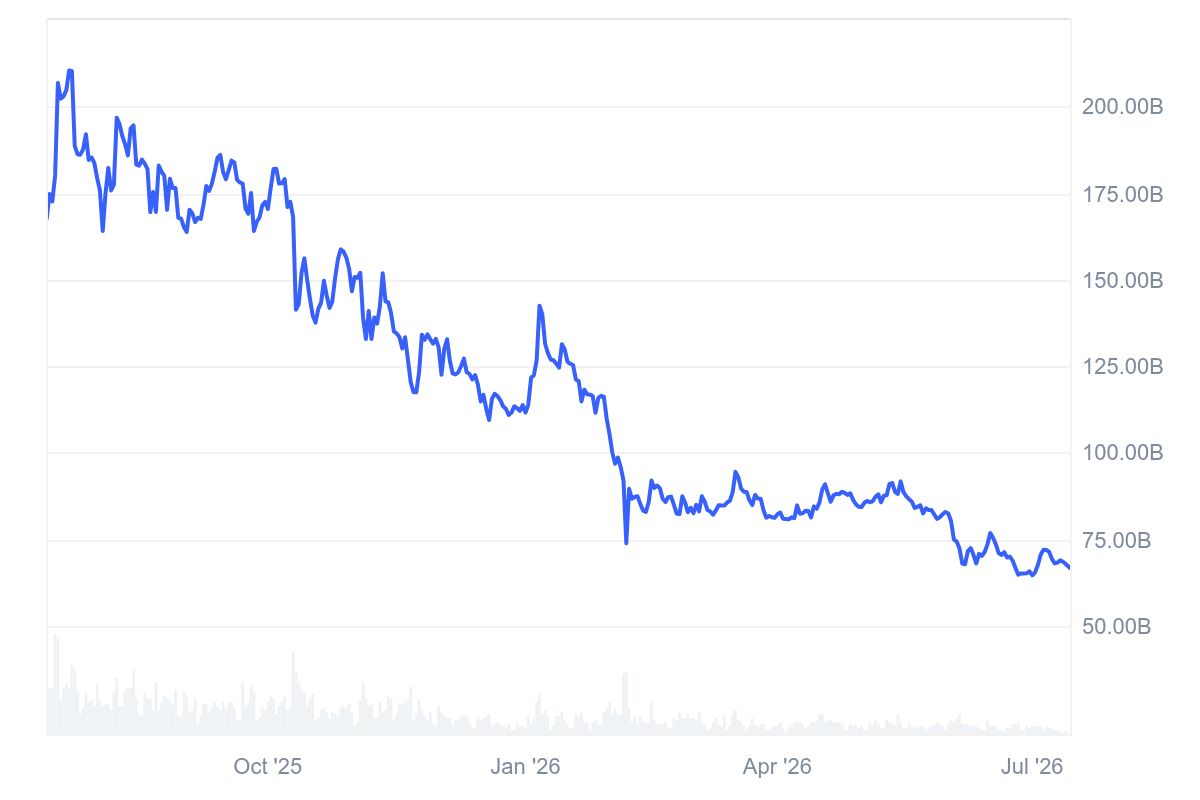
- Standard Chartered projects $4 billion to $8 billion in XRP ETF inflows on CLARITY Act passage. XRP’s market cap near $60 billion at current prices means that the inflow range represents 7 to 13% of the total market cap entering through a single new institutional channel.
- The equivalent figure for Bitcoin, Citi’s $15 billion against a $1.2 trillion market cap, is roughly 1.25%. The marginal impact of new institutional capital is far larger for XRP.
Ripple’s Payments Network Could Finally Scale Under Clear Rules
Third, XRP has a payments infrastructure story that becomes commercially executable the moment statutory clarity arrives.
- Ripple has more than 300 financial institution relationships through RippleNet. Many of those institutions have been cautious about deepening their XRP integration while the risk of securities litigation persisted.
- With the CLARITY Act’s passage, that risk is gone by statute, and the institutional payment corridor buildout that Ripple has been preparing for years can accelerate without legal constraints.
- This is not simply a price catalyst. It unlocks Ripple’s business model, creating long-term commercial opportunities that Bitcoin and Ethereum do not replicate.
The honest caveat is that XRP’s asymmetric upside also comes with asymmetric downside if the bill fails. Bitcoin and Ethereum lose a tailwind. XRP loses a potential transformation. That is the other side of being the most structurally tied asset to a specific piece of legislation.
But if the question is which asset benefits most on passage, XRP is the answer, and the reasoning is not sentiment or community enthusiasm. It is the statutory permanence of commodity classification, a proportionally larger ETF inflow impact relative to market cap, and a payment infrastructure buildout that becomes commercially viable in a way it could not while securities litigation risk remained on the table.
White House Crypto Council Faces Leadership Transition
The White House’s top crypto policy official is set to step away at a pivotal moment for US digital asset legislation. Patrick Witt, Executive Director of the White House Crypto Council, will begin a months-long leave on July 27 to complete Army National Guard Judge Advocate General (JAG) training.
Throughout negotiations on the CLARITY Act, Witt has served as one of the administration’s principal coordinators, working with lawmakers, regulators, and industry participants as the bill advanced through Congress. During his absence, Deputy Executive Director Harry Jung is expected to assume day-to-day responsibilities.
Cody Carbone, CEO of The Digital Chamber, said Patrick Witt had been transparent with industry stakeholders from the outset about his planned military leave. Carbone added that Witt and his deputy, Harry Jung, had positioned the administration well for the CLARITY Act to pass this month, expressing confidence that the leadership transition would not derail the legislation’s momentum and urging lawmakers to complete the process.
Key Implications
Witt’s temporary departure comes as the Senate enters the narrow legislative window before the August recess, when leaders are seeking enough support to bring the CLARITY Act to the floor.
Although the transition is planned and Jung is expected to maintain continuity, Witt’s absence removes one of the administration’s most experienced negotiators during the final stage of discussions over market structure, stablecoin provisions, and ethics language.
Whether the leadership change has any practical impact on the bill’s timeline will likely become clearer as the Senate decides whether to schedule a floor vote in the coming weeks.
Market Reaction and the Road Ahead
Industry leaders remain publicly optimistic despite unresolved Senate hurdles to the bill. SEC Commissioner Hester Peirce said earlier this month that she expects the CLARITY Act to pass this summer, reinforcing the expectation that Congress is approaching the first comprehensive federal market structure law for digital assets.
Sen. Cynthia Lummis has struck an even more urgent tone, warning that missing the current legislative window could leave the US without meaningful crypto market structure legislation for years. She has repeatedly argued that lawmakers are “moving in July” and urged Congress to finish the job before the August recess.
Whether that optimism translates into votes now depends on the Senate. The bill still requires a unified text, 60 votes to overcome a filibuster, and enough floor time before lawmakers leave Washington in August. If those hurdles are cleared, the legislation would move to the House for reconciliation before reaching President Trump’s desk.
Top Trending Crypto Articles
FAQs
The CLARITY Act is proposed US legislation that would divide oversight of digital assets between the SEC and the CFTC, creating a clearer regulatory framework for crypto markets, exchanges, and token issuers.
According to Claude’s analysis, XRP stands to benefit the most because the bill would permanently establish its commodity status in law, strengthen the case for XRP ETFs, and remove remaining legal uncertainty surrounding Ripple’s payments business.
No. The bill has passed the House and advanced through the Senate Banking Committee but still requires Senate approval, reconciliation with the House, and President Donald Trump’s signature before becoming law.
Patrick Witt, Executive Director of the White House Crypto Council, is taking military leave during a critical stage of CLARITY Act negotiations. His deputy, Harry Jung, is expected to lead the administration’s crypto policy efforts while Senate negotiations continue.
The information provided in this article is for informational purposes only. It is not intended to be, nor should it be construed as, financial advice. We do not make any warranties regarding the completeness, reliability, or accuracy of this information. All investments involve risk, and past performance does not guarantee future results. We recommend consulting a financial advisor before making any investment decisions.

Dr. Guneet Kaur is a senior editor at CCN.com and a Science Fellow at Exponential Science. She is a fintech and blockchain expert with extensive experience in digital finance education, blockchain ecosystems, and cryptocurrency markets. She has worked with global media such as Cointelegraph, as well as education and blockchain platforms, to design and lead strategic content and learning initiatives. As an educator and assessor for top-tier executive programs, she bridges real-world fintech trends with academic insight.
Dr. Kaur is also a published researcher and peer reviewer across fintech and data science journals, including Financial Innovation Journal and International Journal of Big Data Intelligence and Applications. Her work spans data-driven analysis, Web3 innovation, and technical content development. With a strong foundation in both industry and academia, she translates complex financial technologies into practical applications, empowering learners, professionals, and institutions across the rapidly evolving digital finance landscape.

