

VIETNAM
Vietnam goes after the little guys
Vietnam will fine retail crypto users up to $1900 if they trade on unlicensed overseas platforms such as Binance, OKX and Bybit, instead of on licensed local exchanges.
There’s just one problem: Vietnam’s Finance Ministry has yet to issue any exchange licenses for its regulated digital asset market which is due to start on September 1. Five exchanges have been approved in principle however.
Domestic investors who trade crypto that’s been designated exclusively for foreign investors can be fined up to $3800. Crypto companies providing or advertising services without a license, those who fail to properly ID customers, or unlawfully deal with crypto account data, can be fined up to $7600.
MALAYSIA
Network school dragged into Israeli citizen controversy
Balaji Srinivasan’s utopian Network School in Forest City, Malaysia is under fire over allegations it has been hosting Israeli citizens using second passports.
The claims trace back to an activist group Malaysia Protest 4 Palestine, which has accused the school of becoming a “gathering place for Israeli entrepreneurs.”
In other countries such a kerfuffle might result in a few BDS protesters or a boycott, but Malaysia has no diplomatic relations at all with Israel, and bans Israeli citizens from even visiting.
That said, dual nationals with Israeli passports are allowed… for now, although the controversy suggests that particular loophole may be closed soon.
Vitalik, Bryan and Balaji at the Network School. (X)
The incident made international headlines after Srinivasan threatened to pull the Network School and its millions in investments out of the country.
The Immigration Department said its investigation had found the 266 foreigners have valid documents, while the Johor state government is plowing ahead with a probe to ensure compliance with regulations on business licenses, building usage and commercial operations.
Ironically, the Network School is based on the concept of online network states, which are meant to be above such petty IRL squabbles.
JAPAN
Japan reclassifies crypto as financial assets
The Japanese parliament has passed revisions to the Financial Instruments and Exchange Act and now classifies cryptocurrencies as financial assets.
The move takes crypto regulations out of the Payment Services Act and comes with a mixed bag of tax benefits along with harsher fines and regulations that befit crypto’s new status up there alongside TradFi assets.
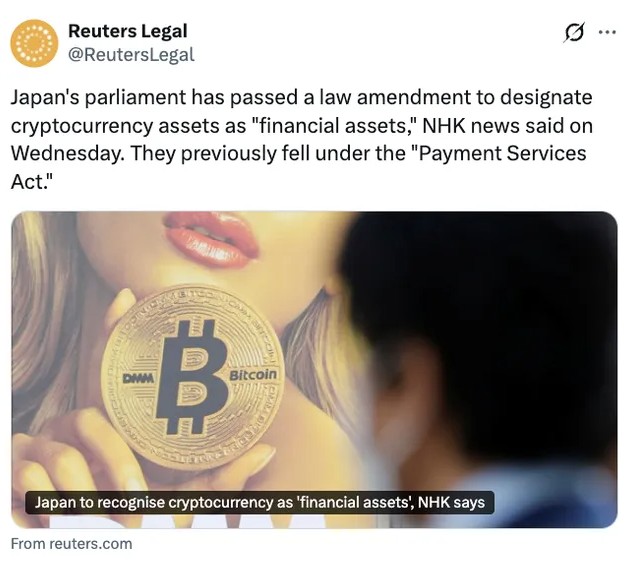
Source: Reuters, X.
Unlicensed crypto platforms face a fine of 10 million yen or 10 years in jail and there’s a new ban on insider trading in crypto that will be policed by the Securities and Exchange Surveillance Commission.
On the upside, current crypto tax rates of up to 55% will be slashed to approximately 20%, with a three year carry forward provision for any losses… which neatly lines up with a bull run every fourth year.
Unfortunately the new tax rules don’t come into effect until 2028.
SOUTH KOREA
South Korea adds crypto to public wealth management rules
South Korea has proposed updating its national asset management scheme to include crypto and IP under the definition of “national assets.”
The Ministry of Economy and Finance announced it is rewriting the 1950 State Property Act, as the National Asset Basic Act, which would make it the first national sovereign asset management statute to embed cryptocurrency.
The existing law was built around an economy focused on real estate which no longer reflects the range of assets the government holds. The new framework also changes the emphasis from managing assets to instead generating value from them. So perhaps we’ll see the Korean Government yield farming on Aave one day soon.
More news from Korea
— South Korea’s Financial Supervisory Service (FSS) has begun sanction procedures against Upbit operator Dunamu, after the platform was hacked for $30 million in November. FSS has been investigating to determine if the incident violated the Virtual Asset User Protection Act, however that law doesn’t provide sanctions for hacks or IT failures.
— That particular oversight is expected to be addressed in the forthcoming Digital Asset Basic Act. Legislators have finally restarted talks on the new act after four months.
— Korea’s Financial Services Commission is extending victim compensation schemes to cover crypto scams.
— Weekly trading volume on Korea’s five top exchanges has more than halved since early June to just 8 trillion won.
— The Bank of Korea will expand its Project Hangang CBDC pilot to nine banks. Phase two, which kicks off in September, also adds biometric payments and person to person transfers.
— Officials from South Korea’s National Tax Service have proposed changing the law to establish clear procedures for seizing self hosted crypto wallets during investigations.
— Consensys unwittingly hired a North Korean dev and gave him access to Metamask’s code. It says an investigation didn’t uncover any security issues.
CHINA and HONG KONG
Is Coinbase allowing Chinese users to verify?
Wu blockchain reports that Coinbase has opened up verification for users who are solely based in China. Previously Chinese users needed to provide a Hong Kong address, but they can now reportedly verify on the platform using only a Chinese ID card and a Chinese address. However, China still does not appear in Coinbase’s list of supported countries.
— Hong Kong has approved its first crypto native tokenized fund from Baillie Gifford, that allows professional investors to have direct ownership of assets on the blockchain.
INDONESIA
— Bybit is launching a regulated platform in Indonesia, following its acquisition of the local NOBI exchange. It will retain NOBI’s senior management team to run the Bybit Indonesia operation.
Cointelegraph publishes long-form journalism, analysis and narrative reporting produced by Cointelegraph’s in-house editorial team with subject-matter expertise. All articles are edited and reviewed by Cointelegraph editors in line with our editorial standards. Content published in here does not constitute financial, legal or investment advice. Readers should conduct their own research and consult qualified professionals where appropriate. Cointelegraph maintains full editorial independence.

