UK FCA Considers Exempting Rules to Drive Tokenized Gold & Commodities Adoption

Wonder debuts its first robotic meal assembly system after acquiring the tech from Sweetgreen
- Investment Opportunities Markets
 Peter Lynch
- 8 minutes read
The entrepreneur Marc Lore posits that in the not-so-distant future, an autonomous kitchen will have the ability to whip up pizza, burgers, chicken, and seafood without any human involvement.
His restaurant tech startup, Wonder, took one step closer to that vision in August when it debuted its robotic meal assembly system, Infinite Makeline.
At the company’s Midtown East location in New York, Infinite Makeline has the ability to autonomously produce up to 500 bowls per hour from 68 ingredients. Wonder promises that by 2027, “tens of locations” across the Northeast, the Washington metro area, and Texas will house Infinite Makeline machines.
By embracing automation of this magnitude, Lore says that he can cut labor and operating expenses, while also boosting a Wonder location’s throughput, and pass along those savings to diners.
“The goal is to get the price of your food delivered to your door cheaper than getting deliveries and cooking,” Lore tells Fast Company. “Feeding families 21 meals a week is the ultimate goal.”

Wonder, which in July announced a $650 million Series D round at a $9 billion valuation, is the latest tech endeavor spearheaded by Lore.
He previously founded and sold the e-commerce platform Quidsi to Amazon for $545 million in 2010, then created and sold another e-commerce startup, called Jet.com, to Walmart for $3.3 billion.
After the latter deal, Lore led Walmart’s U.S. e-commerce business for nearly half a decade before leaving to create Wonder.
Eating big
New York-based Wonder operates a sprawling and complex business, with 160 locations, mostly along the East Coast. It’s also growing through far-flung acquisitions across the food industry.
Those include the $103 million takeover of the meal-kit company Blue Apron in 2023 and a $650 million deal for the mobile food delivery platform Grubhub in 2024.
And late last year, Wonder paid the salad purveyor Sweetgreen $186.4 million for Spyce, which developed the Infinite Makeline technology. Sweetgreen still operates around three dozen of those machines under a licensing agreement.
While visiting Wonder’s Midtown East location, I was given a tour by Kale Rogers, a cofounder of Spyce who now serves as senior vice president of automation at Wonder.
He explained that the restaurant was capable of making food from six different restaurant concepts, including salad and poke bowls, and cuisines varying from Mexican to Mediterranean. “Really, anything that can kind of go in a bowl or plate,” Rogers tells me during our interview.

Rogers says that Infinite Makeline automates about 80% of the food that goes into the bowl in about three and a half minutes; workers add sauce packets and other finishing touches at the end.
Chefs provide their input too. Culinary pros wanted the rice to be firmer at the bottom of the poke bowls; Wonder responded by modifying the system so that those containers would take an extra lap to ensure the rice got extra smushed while being seasoned.
Human involvement is still core to the effort
Menu concepts will always have human involvement, Rogers says, adding that Wonder’s opportunity for growth is centered on “how we can create an incredible amount of variety, an incredible amount of personalization just for you, and do it really quick and at scale.”
At Wonder’s Midtown location, there is still quite a bit of human involvement. Workers prep the food and refill eight cases filled with dozens of ingredients ranging from romaine lettuce to chicken, tuna, and carrots. They also handle packaging in to-go bags, taking the handoff from a large robotic arm.
Across the industry, restaurants have embraced automation ranging from digital kiosks to take orders, artificial intelligence that can take a drive-through order, and delivery robotics.
And yet, some chains are discovering hospitality still needs humans. As The Wall Street Journal recently reported, McDonald’s, Burger King, and other big chains are spending more on training to make their restaurants warmer for guests.
Lore takes a contrarian view, centered on lowering costs, which requires less labor. “The big vision is to create a fully autonomous food platform that’s capable of autonomously planning, cooking, and delivering your food, so that we can make great food much more accessible,” says Lore.
That food platform, according to Lore, is able to serve 700 different meals per location, but in the future, up to 10,000 will be whipped up through automation to appeal to a wide variety of food preferences, health goals, and budgets.
There is also quite a bit of AI and robotics underway at Wonder in Lore’s quest to make food far more autonomous.
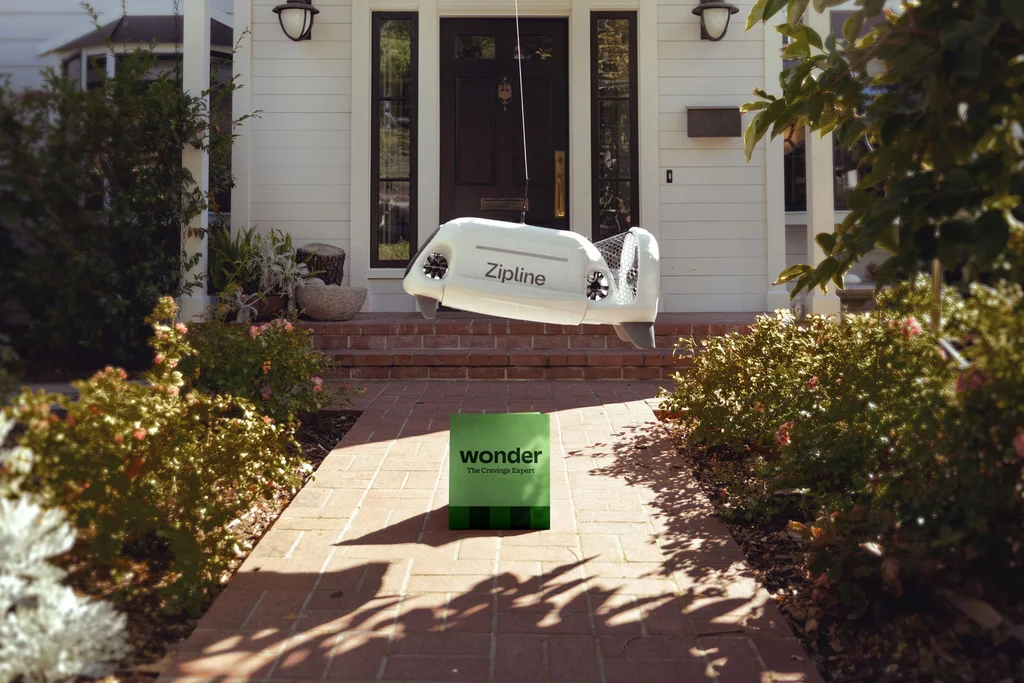
Sidewalk drones are delivering Wonder’s food in cities including Los Angeles and Chicago through a partnership with the tech firm Serve Robotics. With yet another autonomous service provider, Zipline, Wonder plans to start aerial food delivery in Texas by January 2027.
There are also a few internally developed autonomous systems underway at Wonder, including the Infinite Sauce Machine, a robotic device that can create hundreds of sauces from 152 raw ingredients including oils, spices, and acids, making up to 500 different curry, mole, and pesto per hour.
Lore and Wonder are also internally developing an AI platform called MEL, which can take into account an individual’s biomarkers, body composition data, food preferences, and health goals to generate machine-crafted meal recommendations.
A beta version of MEL is expected to debut by next year. But for Lore, he’s already noticed some health changes. Throughout the year as he’s been using the tool, MEL has gotten Lore to add more kelp to his diet to boost his iodine levels, while raw walnuts have increasingly been mixed into breakfast oatmeal to address high cholesterol.
“It started to make subtle changes to fix my health, but still solving for the food I love,” says Lore.
investment News

