Meet the Portland Fire owners: How the Bhathals went from swimwear moguls to WNBA franchise buyers

Cannabis consumers are no longer stoner stereotypes. Not all brands are marketing accordingly
- Investment Opportunities Markets
 Peter Lynch
- 17 minutes read
When it comes to marijuana, millennials may be the last generation of Americans to grow up when Amsterdam still had a whiff of the mystical. For those who were cannabis-curious in the ‘90s and early-aughts, Amsterdam represented an impossible dreamland where one could simply walk into The Weed Store and legally purchase what then amounted to contraband stateside.
In that restricted atmosphere, cannabis culture flourished as counterculture, its pothead slogans and hazy-brained imagery acting as illicit in-group signaling. Those who stumbled into head shops lined with posters of an alien smoking a blunt or a Taz with eyes as red as the devil may have once nodded along to the unmistakable messaging. But that was decades ago.
Federally, marijuana remains a Schedule I drug and an estimated 32,000 Americans are in prison for charges related to its sale. Now that legalized cannabis at the state level is increasingly mainstream, though, evolving from dorm-room stash to Mom’s trusty sleep aid, most of the half-baked signifiers associated with it have become creaky relics of the past. While some players in the cannabis space are dynamically defining the market as they go, others are mired in a crusty bong-chamber of outdated jargon and visuals. Consumers who might have once been surprised to find a dispensary opening nearby are now more likely to be surprised that the one opening nearby is so cringe.
In 2026, legal cannabis sales are expected to be $30.5 billion, an increase of 4.9% over 2025. Hungry companies are trying to carve out a bigger slice of that pie with their branding, and most falls into one of two camps. There’s the old-school model, which treats cannabis like the world’s worst-kept secret, and the emerging one, which treats it like a party where absolutely everyone (of age) is invited.
It shouldn’t come as much of a surprise the latter type seems to be winning.

It’s always 4:20 somewhere, unfortunately
Before U.S. states began legalizing cannabis for recreational use in 2012, the product never needed to be marketed—it sold itself.
As regulations first loosened, the same logic largely applied. All a dispensary or cultivator needed to advertise back then was that the product was, in fact, cannabis. In that early gold rush—or, rather, green rush—a lot of brands didn’t overthink their packaging. Jake Bullock, CEO of Cann, a national THC beverage maker that generated nearly $40 million in revenue last year, recalls launching in 2018 amid a parade of stereotypical brands with a common design theme.
“If you’re trying to communicate this is the cheapest way to get high, a green pot leaf is a pretty good way of doing that,” he says, having opted instead for Cann’s leaf-free pastel tones.

Now that adult-use cannabis is legal in nearly half the U.S., and beverages containing THC derived from hemp are available in mini-mall wine shops and at Lollapalooza, the landscape is too crowded with sellers for the entry-level stoner-bait of yesteryear. Or at least it should be.
“There’s probably nothing lazier now than a cannabis brand with a green logo that has a pot leaf in it,” says David Paleschuck, author of Branding Bud: The Commercialization of Cannabis.
Still, a 2024 study of 1,229 brands of edibles revealed 32% of them contained images of a cannabis plant (excluding the legally required universal cannabis symbol). A quick scan of dispensary listings from the Office of Cannabis Management in New York State reveals an abundance of shops with outdated names like 420 Bliss, My Bud 420, and 420 Expressway, all referencing the number most associated with weed, for complex yet boring reasons.
Too many brands still market themselves as though the mere prospect of any cannabis whatsoever is enough to bring consumers to the table—and their vision of that consumer is built on stoner tropes from at least 30 years ago.
In reality, cannabis has become demystified enough to expand consumer demographics far beyond any imagined target audience of heavy-lidded burnouts. And many of its champions now want more out of a cannabis product than cannabis.

The many-splendored colors of the cannabis rainbow
So, if savvy THC brands know what to avoid, what should they be doing instead?
Many of them are already doing it.
“I think there is a trend moving away from the stoner brands, and moving toward real consumer archetypes like foodie brands, luxury brands, and wellness brands,” says Palesheck, referring to the burgeoning crop of brands touting curated ingredients, health benefits, or flashy packaging.
The trend isn’t restricted to products either. Dispensaries are changing from the dingy, well-guarded weed-bunkers of a decade ago to something new.

Penelope Nam-Stephen, CEO of the chic New York City dispensary The Travel Agency on Fifth Avenue and in SoHo, notes that the varied appeal of cannabis is part of the idea behind her shops, whose classy look is inspired by the clean, 1960s aesthetics of the TWA Hotel at JFK.
“The travel theme means you can go somewhere without going somewhere, because cannabis brings many different people to many different places,” Nam-Stephen says. “It doesn’t have to be something where you’re just getting stoned out of your mind—it can be spiritual, it can be a sleep thing, or it can go somewhere else.”

The idea of branding cannabis goods according to specific benefits of the plant is what Rosie Mattio, founder of cannabis PR firm Mattio Communications, calls “effects-based architecture.”
“When New York was starting to legalize [in 2021],” she says, “that’s when we really started seeing this proliferation of cannabis brands, and a lot of them were promoting things like ‘calm’, ‘create’, ‘cultivate’, ‘connect’—helping people understand these different effects.”
In contrast, the quiet promise of brands still leaning into the 420 of it all seems to be potency, a holdover from the era when the most reliable consumers were those with the highest tolerance. There’s a lot a cannabis company can do, however, in avoiding potency as a value proposition. In fact, for brands appealing to THC rookies, de-emphasizing potency can be a shrewd strategy.
Mids are gas now
“Folks that have experiences with THC [tetrahydrocannabinol, cannabis’s psychoactive ingredient] more often than not can tell you a story where they consumed too much of it and it was not a pleasant experience,” says Bullock at Cann, the THC beverage company. “People are afraid of getting too high, so we really started from a foundation of, ‘How do we communicate that this is social, and it’s not gonna be too intense?’”

Part of the way Cann achieved that goal is with an unintimidating 8 oz. can that carries a low dose of 2, 3, or 5 milligrams of THC per serving—though the brand now offers tallboy cans, which they call “hi boys”—along with sleek line art tracing the shapes of the fruity ingredients in each flavor.
Other beverage brands selling in multiple states also design their cans in similarly inviting ways, a far cry from the 100 mg heavy-dose drinks that were popular in dispensaries before the market started gravitating toward THC beverages that hit like an after-work glass of wine.

At this point, even Cheech & Chong—the weed-rascals long synonymous with comedic cannabis culture—offer THC drinks that don’t look like their fans might expect. The pair’s High & Dry line, for example, features bright, poppy colors and not a pot leaf in sight. Over the years, the brand has even phased out from the can its former decorative caricatures of the duo in their prime, looking—it must be said—higher than giraffe ass.
“There’s so much personality and history behind Cheech & Chong, and our design team does an incredible job finding ways to honor that legacy without feeling like we have to rely on the traditional visual language of cannabis,” says Brooke Mangum, CMO of Cheech and Chong Global.
However, even high-potency cannabis form factors, like preroll joints or flower—the name now given to the smokable part of the plant—come branded in ways that defy outdated expectations. For instance, while the preroll line Dogwalkers is, according to Green Thumb Industries CEO Ben Kovler, “not for the amateur smoker,” potency is not part of its branding. Kovler coined the term “dogwalker” to describe smallish joints one might bring on a starlit stroll with a furry friend. The prerolls come in a snazzy forest green tin, the name conveyed in raised, gold lettering.

“It’s a premium, luxury look that doesn’t stand out in, say, your purse,” Kovler says.
Rather than get in consumers’ faces about just how dank this kush is, or something similarly old fashioned, Dogwalkers coined a term that advertises how it might accentuate a lifestyle.
Best of both worlds
In a category as large as legal cannabis has gotten, there’s plenty of room for branding that treats cannabis as any other consumer good, alongside the more Stoney McPotface approach.
What may matter most, though, is intentionality; the sense that this product was created with an idea in mind, not simply churned out along the historical path of least resistance.
“Some brands come to us and they’re still calling themselves Canna-something. Like, come on, guys—we can do better than this,” the branding expert Mattio says. “I think some of them feel like, ‘Hey, we have to let people know this is weed,’ and the leaf makes it intuitive, but to me it lacks creativity.”
Anyone wading into classic stoner aesthetics at this late date need only apply a little ingenuity—or, at least, variety—to make it work.
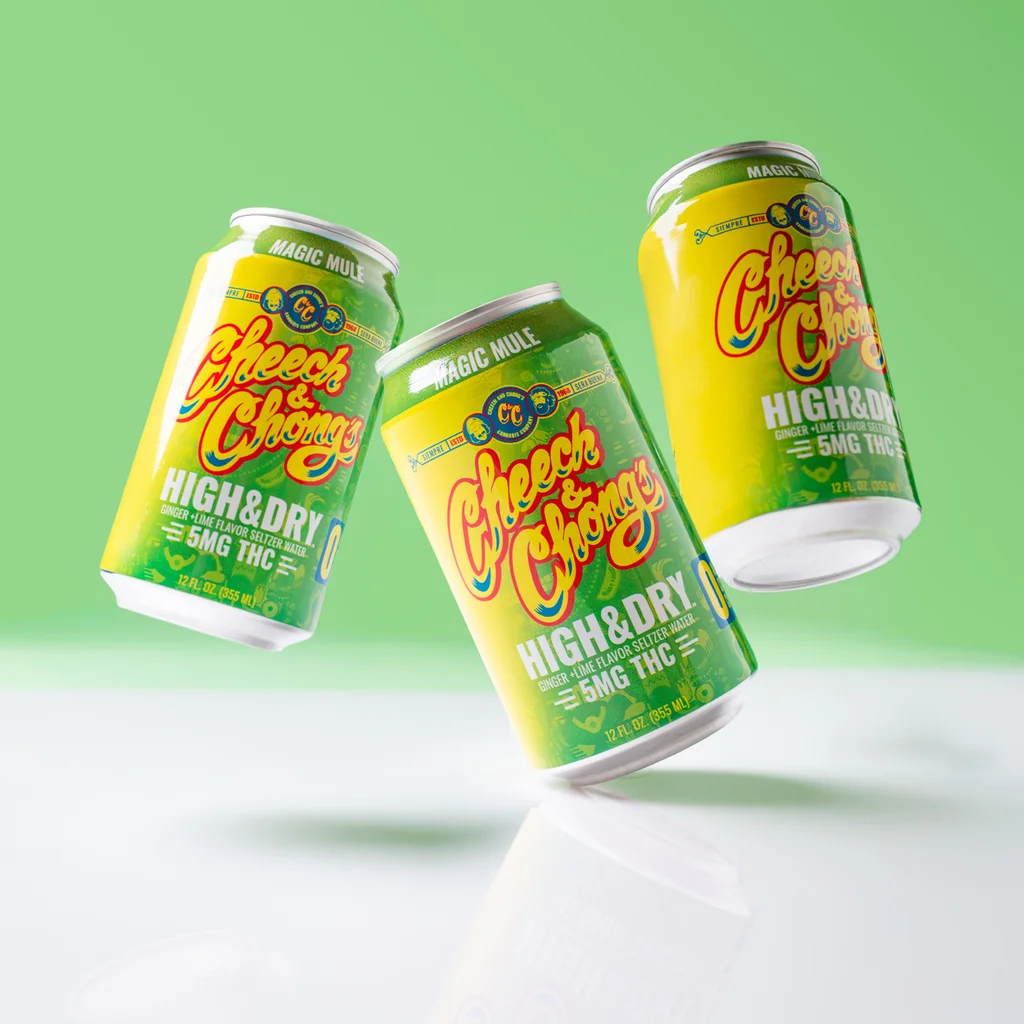
Cheech & Chong, for instance, may have their mass market THC beverage line High & Dry, but they also offer a bottle of THC “spirit” that features the pair’s old catchphrase, “It’s fuckin’ weed, man,” on the packaging and, uh, converts into a water bong. Similarly, although Green Thumb’s Rythm, a leading national flower brand, comes with a subtly vibey logo, where the H has a sine wave in it, Rythm has branded its top-selling strain, Animal Face, with plenty of resin-drenched art and lore online, including an image of a cosmic puma with three eyes.
An enterprising, nimble brand can find ways to appeal both to people who like to unwind with a 5 mg gummy after an especially long day and those who’ve made weed their entire personality.

As legalization keeps broadening the parameters of cannabis fandom, experts say savvy brands should keep in mind they’re not just servicing the existing fans but potentially cultivating new ones.
“Our best customer hasn’t even heard of THC drinks yet,” says Bullock at Cann. “They’re picking up a bottle of Chardonnay for book club this week, and they’re going to love THC when they find it. It’s coming for them, even if they don’t know it yet.”
investment News