Evolv Technologies director Michael Ellenbogen sells $451,403 in stock By Investing.com

These 60-sided dice never have to be rolled twice
- Investment Opportunities Markets
 Peter Lynch
- 3 minutes read
A standard six-sided die has one simple shortcoming: You’ve got a 1 in 6 chance of getting the same number as your opponent when you’re rolling to go first in a game.
Eric Harshbarger has a solution for that.
More than a decade ago, Harshbarger, a senior lecturer at Auburn University’s College of Sciences and Mathematics, and a group of mathematicians and computer scientists embarked on a journey to create a set of five dice that would be unimpeachably fair. Their parameters? Rolling the dice should never result in a tie, and every player should have a mathematically equal chance of rolling the highest number.
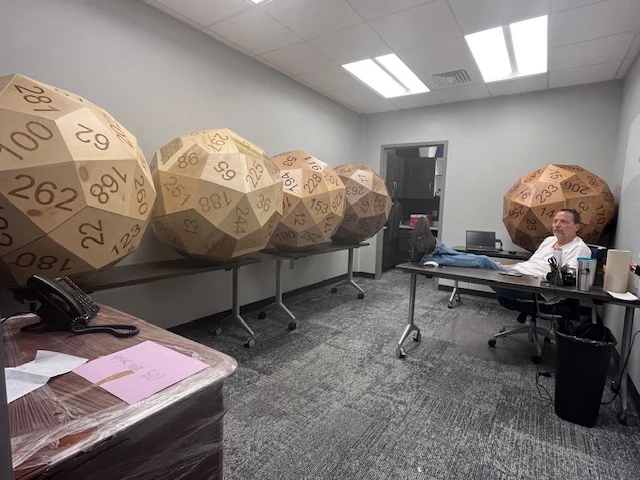
After many iterations, they finally came up with a design that works. They created the Go First Dice, a set of five 60-sided dice, with the numbers 1 through 300 spread across their faces.
Their dice are now represented in a sculpture at Auburn University’s new STEM + Agricultural Sciences Complex. The pieces of the sculpture are fashioned from different types of wood—pine, poplar, red oak, walnut, and mahogany. Each weighs more than 100 pounds and is about three-and-a-half feet in diameter.
The idea for the dice came from a conversation Harshbarger had with James Ernest, founder of Cheapass Games, at a gaming convention in 2010. Ernest wondered if it was possible to create no-tie dice. Harshbarger found the question to be an intriguing math problem to solve.
“I don’t think he [Ernest] had any idea so much research would be thrown at the question,” Harshbarger says. “There are plenty of much easier ways to fairly decide who goes first in a board game, but the mathematics behind the question fascinated me, and the quest for sets of ‘Go First Dice’ began.”
investment News
board game,board game design,dice,Math,math nerds,mathematics

