CFOs are hitting a ‘cost wall’ on AI
- Investment Opportunities Markets
 Peter Lynch
- 0
- 9 minutes read
Good morning. For many companies, the biggest surprise in scaling AI isn’t performance—it’s the bill. Tokens, the units behind every AI interaction, are quickly becoming a key driver of cost and scrutiny.
In a new report released this morning, “AI is on your P&L. Most companies are only reading half of it,” Accenture’s Chief AI and Data Officer Lan Guan, a coauthor, argues that many companies are underestimating the financial implications of scaling AI. The issue is not just technical—it is managerial, cultural, and also revolves around token use, increasingly, a core concern for CFOs.
“My token cost from cloud code is shooting through the roof—this is a CFO conversation that I’m having constantly,” Guan told me. “Clients are ready to scale AI, but then they hit this unexpected cost wall.”
A lot of CFOs at large enterprise companies don’t even know where all these token costs are coming from, she explained; they just get the bill. Questions arise like: Who’s using tokens? Who’s building agents? Which product is contributing the most to the token consumption? “They’re literally telling me that they are walking in the dark,” Guan said.
One retail client, for example, deployed an AI-powered recommendation engine in a handful of pilot stores. The result: a monthly cloud bill in the millions, driven largely by token consumption. “Sales were increasing,” Guan said, “but the cost structure wasn’t anticipated.”
Practicing tokenomics
Guan discussed the broader concept of tokenomics—the discipline of connecting AI consumption to business value. Every prompt, response, and autonomous agent interaction consumes tokens, and as AI systems become more sophisticated, usage can scale from thousands to millions—or even trillions—of tokens.
She points out that Goldman Sachs reports AI-related spending is tracking to hit more than $800 billion in 2026. However, just 23% of C-suite leaders Accenture surveyed report widespread and sustained business value from AI across their organization.
Accenture, which moved up seven spots to No. 204 on this year’s Fortune Global 500, also took a look inwardly. One of its internal platforms processes roughly 8.7 trillion tokens per week. To manage that scale, the firm developed an “AI Token Navigator,” a system that routes workloads to the most appropriate model—whether frontier, mid-tier, or open-weight—based on the task’s complexity and business importance. Guan said this approach can reduce costs to roughly one-sixth of relying solely on top-tier models, which are usually the most pricey.
Accenture estimates that only 10-20% of enterprise tasks are complex enough to justify frontier or near-frontier capability.
A three-step framework
But technology alone is not enough. Guan points to the Jevons Paradox, an economic principle that suggests efficiency gains often lead to increased consumption. As AI becomes cheaper and more accessible, employees use it more frequently—and often default to the most powerful, and expensive, models.
“That single behavior, multiplied across a workforce, is where consumption costs quietly balloon,” she said.
To address this, Accenture is pushing clients to treat token management as an enterprise discipline. Guan outlines a three-step framework for CFOs to consider: “See it, treat it, manage it”:
—First, organizations must gain visibility into where token usage is occurring. CFOs are seeing only aggregate bills without understanding the underlying drivers. In one internal analysis, Accenture found usage of a single AI tool increased 113-fold in just 10 weeks, with 19% of users accounting for roughly 80% of the spend.
—Second, companies must optimize architecture—routing tasks to the right models and identifying inefficiencies. Finally, they must institutionalize ongoing monitoring and behavioral change, embedding cost awareness into everyday AI use.
—Crucially, Guan emphasizes that this is a cross-functional effort. “This is a team sport,” she said, requiring coordination across finance, technology, and even cybersecurity, which can add what she calls a “shadow tax” to AI costs.
“AI scale doesn’t have to mean runaway cost,” Guan said. “But you have to build the harness around it.”
Sheryl Estrada
[email protected]
Leaderboard
Carmen Chan was appointed CFO of ZipRecruiter (NYSE: ZIP), an online employment marketplace, effective Aug. 17. Chan joins ZipRecruiter from Barclays, where she served as managing director, advising technology and internet companies. Before that, Chan spent several years at Noom, a digital health company, as VP of corporate development and investor relations. Prior to Noom, she spent more than five years at Goldman Sachs where she held investment banking roles within the technology, media and telecommunications group. She also previously served as head of revenue and business development at theSkimm, a digital media company.
Ryan Moore was appointed CFO of Whataburger, effective July 31. Moore succeeds Janelle Sykes, who will retire in September after more than six years with Whataburger. Moore’s 16 years of restaurant finance leadership include six years as CFO of Torchy’s Tacos and 10 years at Taco Bell, where he served as VP of finance.
Big Deal
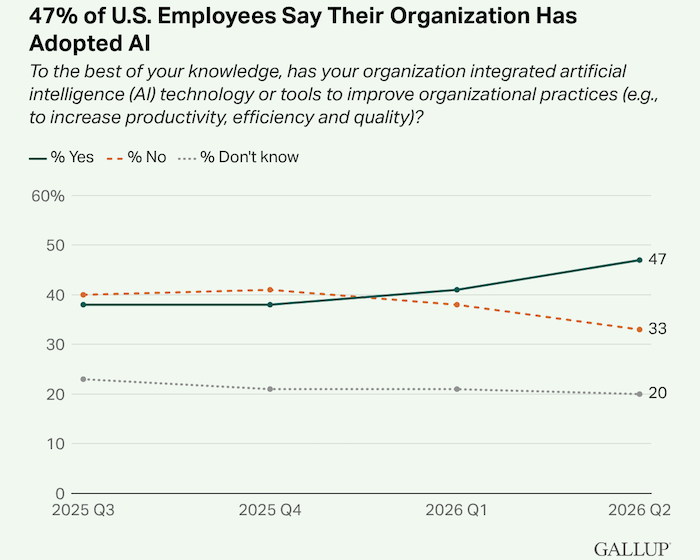
New data from Gallup finds that approximately 15% of U.S. employees now use AI daily in their role. This has risen from when it was first measured in the second quarter of 2023, when only 4% of employees reported the same. More than half of U.S. employees (52%) now use AI to some degree in their role, according to the report.
Meanwhile, as reported by employees and mirroring individual use, workplace integration of AI for achieving organizational goals jumped from 41% to 47% in the second quarter.
Going deeper
“No. 1 on the Fortune Global 500: Amazon’s Jeff Bezos on how his garage startup became the largest company in the world by revenue” is a Fortune feature article by Kristin Stoller.
Stoller writes: “Jeff Bezos won’t pretend he didn’t see this day coming. Sure, when he was sitting in his Bellevue, Wash., garage in 1995, at a makeshift desk made from a wooden door slab, he probably wasn’t imagining that his nascent online bookshop would grow into the largest company in the world.” Read more here.
Overheard
“This is the first time when really both sides have been unhappy. The market just isn’t working for either side.”
—Greenhouse CEO Daniel Chait told Fortune. Job seekers are tired of shooting résumés into the void and getting ghosted, and many have started paying for AI tools that blast their application out to every open role they can find. But according to Chait, employers are just as miserable—and he’s got a name for the hiring situation: an AI doom loop. Read more here.
investment News
CEOs, CFOs, CFO, CEO, chief financial officer, finance chief, chief financial officers, Kickstarter, Kickstarter's new finance chief is ultra-extroverted—and she credits that trait to her success as a people-centric CFO, Sindy Wilson, Everette Taylor, people-centric, people, talent, tech company